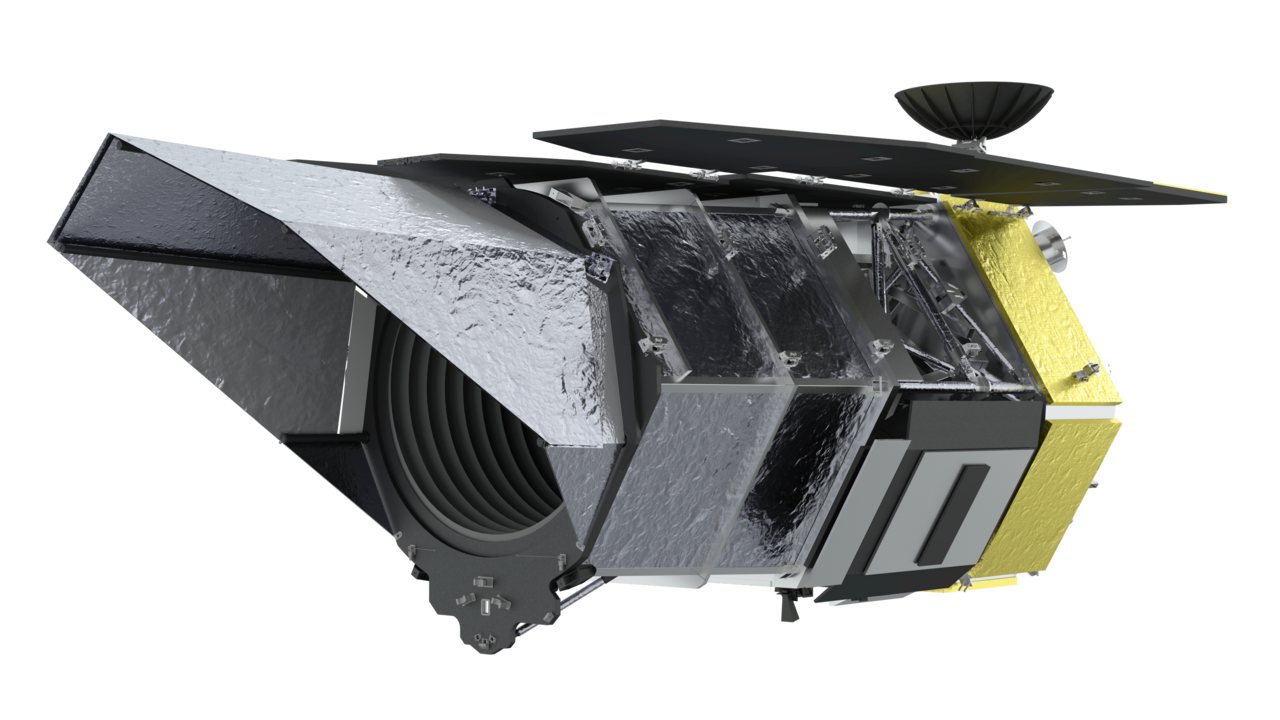
NASA's Roman Space Telescope has reached a critical milestone in its development, demonstrating pointing stability so precise that it can stay locked on a target with an accuracy comparable to aiming a laser at a dime from roughly 150 miles away. The observatory's powerful coronagraph, an instrument designed to block starlight and reveal faint planets, has also captured its first focused images of stars in the Large Magellanic Cloud, confirming that the system can produce the sharp images needed for its planet-imaging mission.
The pointing stability test represents a significant achievement for the mission, which is designed to survey vast regions of space with unprecedented efficiency. The telescope's ability to maintain such precise aim is essential for its coronagraph to work properly, as even minute drifts could blur the faint light of distant planets. The successful capture of stars in the Large Magellanic Cloud, a satellite galaxy of the Milky Way, demonstrates that the coronagraph's optics and alignment are functioning as intended.
The Roman Space Telescope, named after NASA's first chief of astronomy, is expected to revolutionize the study of exoplanets and dark energy. Its coronagraph is a technology demonstrator that will pave the way for future missions aimed at directly imaging Earth-like planets around other stars. By blocking the glare of a host star, the instrument can reveal the much fainter light reflected by orbiting planets, allowing astronomers to analyze their atmospheres for signs of habitability.
While the primary source focuses on the Roman telescope's achievements, additional research highlights the broader context of solar and space observation. A separate study led by Marco Marongiu of INAF Cagliari has used radio telescopes to examine coronal holes, regions of the Sun's atmosphere where the magnetic field opens into space and generates the fast solar wind. The team analyzed about 500 radio maps of the Sun, comparing them with extreme ultraviolet observations from NASA's Solar Dynamics Observatory. They found that coronal holes can appear very different depending on the wavelength used, with some appearing brighter in radio images rather than darker.
This discrepancy arises because radio observations at frequencies between 18 and 26 GHz probe different layers of the solar atmosphere, including the upper chromosphere and the transition region to the corona. The researchers suggest that the unexpected brightness in some radio-dark regions may be due to numerous small magnetic structures, such as coronal bright points, that are too small to be resolved individually but collectively emit enough radiation to appear as a larger, brighter area. The study also identified a possible radio counterpart to a dark halo, a structure that can surround active regions on the Sun.
These findings, published in Solar Physics, underscore the importance of multi-wavelength observations for understanding the Sun's complex atmosphere and the origins of the solar wind. The observations were conducted using the Sardinia Radio Telescope and the Grueff Radio Telescope in Medicina, Italy. Together with the Roman Space Telescope's progress, these developments illustrate the ongoing efforts to refine our understanding of both distant planetary systems and our own star's dynamic behavior.
12