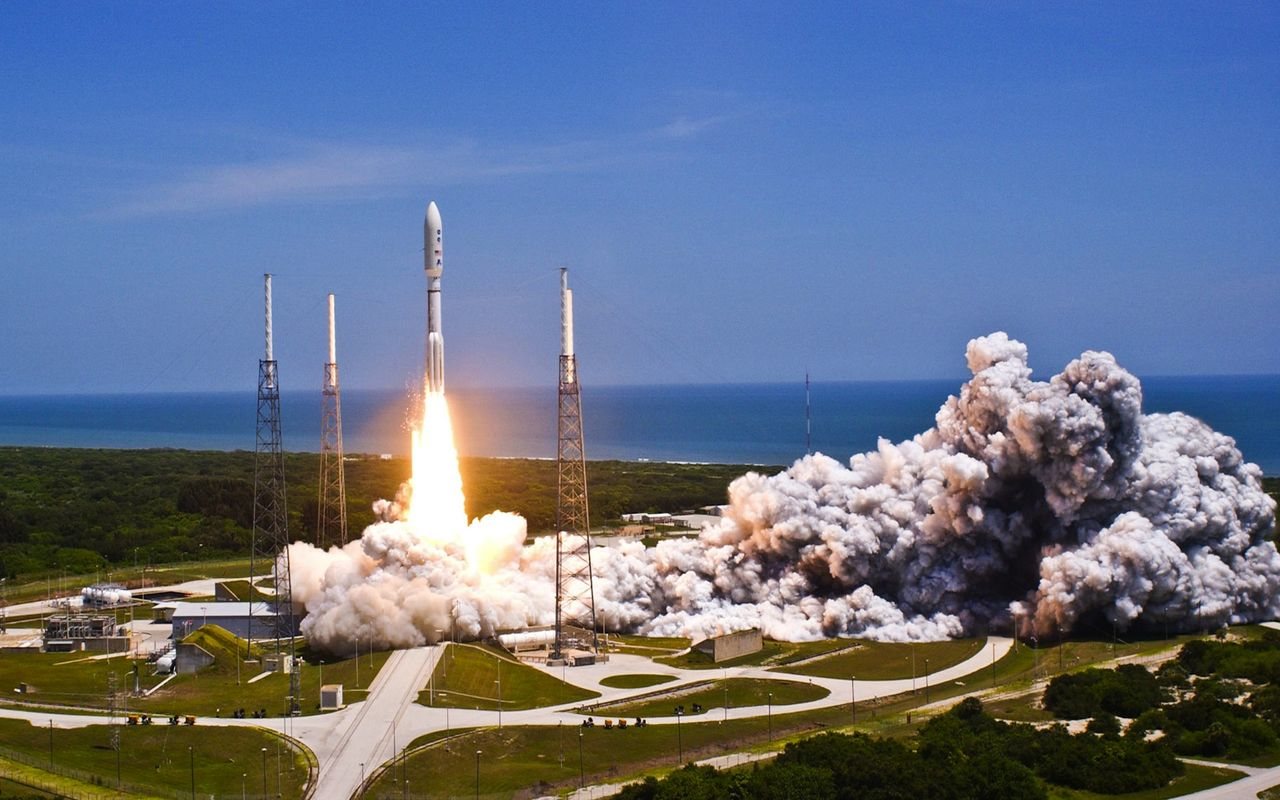
NASA’s Juno spacecraft, one of the most ambitious planetary missions ever launched, lifted off on Aug. 5, 2011, from Cape Canaveral Air Force Station in Florida. Riding an Atlas V rocket, the solar-powered probe set off on a journey of nearly five years to Jupiter, the largest planet in the solar system. Juno was designed to study the gas giant from orbit and to look beneath the clouds that have obscured its surface from the earliest telescopes.
Juno’s path to Jupiter was not a straight line. In 2013, the spacecraft returned to Earth for a gravity-assist flyby, using our planet’s pull to gain speed and reshape its trajectory toward the outer solar system. The maneuver worked, and Juno arrived at Jupiter on July 4, 2016. After firing its main engine, the spacecraft settled into a highly elliptical polar orbit, arcing high above the planet before plunging close to its cloud tops. That unusual orbit allowed Juno to sample regions of Jupiter’s magnetic and gravity fields that earlier missions had never measured so directly.
The science goals were bold. Jupiter is made mostly of hydrogen and helium, but the details of its interior remain hard to observe. Researchers wanted to measure how much water the atmosphere contains, a clue to the abundance of oxygen and to how the planet formed. They also wanted to determine whether Jupiter has a solid core, how deep its colorful bands extend, and how its giant auroras and magnetic field work. To answer those questions, Juno carried a suite of instruments including a microwave radiometer to see below the clouds, magnetometers to map the magnetic field, and the JunoCam camera, which offered the public unusually close images of the planet.
Juno delivered unexpected results within months of arriving. It found that Jupiter’s poles are covered by a dense cluster of cyclones arranged in geometric patterns, including a pentagonal array around the north pole. The mission also showed that the planet’s magnetic field is stronger and more uneven than expected and that the Great Red Spot, the giant storm observed on Jupiter for centuries, extends far deeper into the atmosphere than scientists had thought. Measurements of the gravity field indicated that the planet’s interior is complex, with a diluted core rather than a simple solid central mass.
The mission did not stop after its first close looks. After completing its prime science phase in 2021, NASA extended Juno’s operations, allowing the spacecraft to investigate Jupiter’s rings, faint moon system, and the large Galilean moons. Juno has made close flybys of Ganymede, Europa, and Io, returning images and data that add context for other missions, including the Europa Clipper spacecraft and the European Space Agency’s Juice mission, both designed to continue the exploration of the Jupiter system. Passing near Io has given scientists a look at the most volcanically active body in the solar system.
As a NASA New Frontiers mission, Juno was built to be relatively focused and cost-capped while targeting one of the highest-priority questions in planetary science. Its results matter far beyond Jupiter. Giant planets like Jupiter helped shape the architecture of the solar system, and understanding them is important for interpreting planets discovered around other stars. By revealing what lies beneath Jupiter’s clouds, Juno has given researchers a sharper picture of how gas giants form and evolve, both here and beyond.
More than a decade after launch, the spacecraft remains active in an extended mission, continuing to send back measurements and images. Each pass over Jupiter adds to a dataset that will be studied for years after the mission ends. The launch that began on Aug. 5, 2011, ultimately produced one of the most detailed views ever obtained of the solar system’s giant planet.