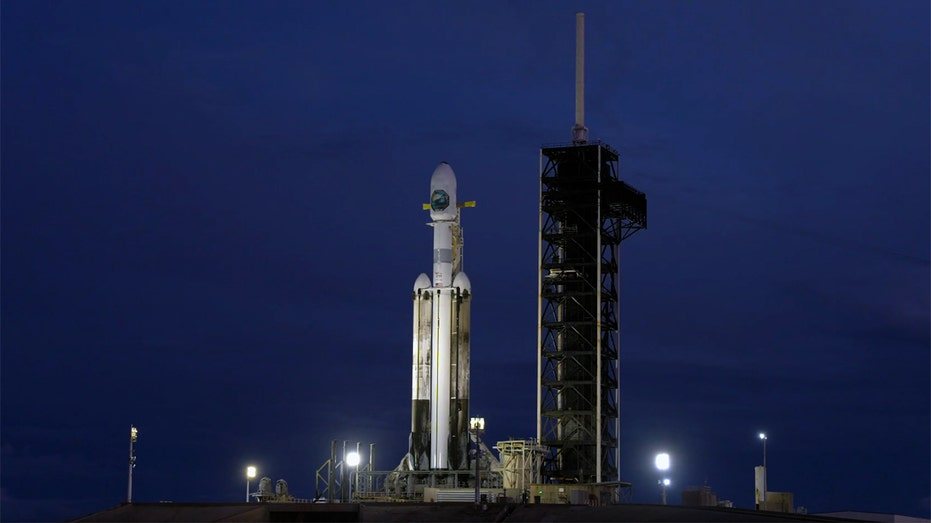
SpaceX successfully launched its Falcon Heavy rocket shortly before midnight Thursday from Launch Complex 39A at NASA's Kennedy Space Center, carrying a classified national security payload for the National Reconnaissance Office. The mission, designated NROL-97, marks another high-profile flight for the triple-core rocket and the U.S. agency responsible for operating the nation's reconnaissance satellites.
About seven to eight minutes after liftoff, the Falcon Heavy's two side boosters returned to Landing Zones 1 and 2 at Cape Canaveral Space Force Station. The synchronized landings generated the familiar double sonic booms that rattled windows and echoed across the Space Coast. The sounds were heard most clearly near Cape Canaveral and Cocoa Beach and more faintly farther inland. The sonic booms occurred as the returning boosters slowed through the speed of sound during their descent.
The NROL-97 mission capped an exceptionally busy day for SpaceX. The launch followed Thursday morning's successful Crew-13 mission to the International Space Station and another Falcon rocket launch from California earlier in the day, making it one of the company's busiest launch days of the year. The back-to-back-to-back flights underscore the rapid cadence SpaceX has achieved across its launch sites.
The Falcon Heavy's side boosters had previously supported the GOES-U, Viasat-3 F3 and Nancy Grace Roman Space Telescope missions before flying again on NROL-97. Their reuse on a national security mission highlights the growing role of recovered hardware in sensitive government launches.
The National Reconnaissance Office does not disclose details about the payloads it launches, and no information about NROL-97's capabilities or orbit was released. The agency's missions support U.S. intelligence gathering and typically involve advanced satellite technology.
Residents along Florida's Space Coast are accustomed to sonic booms from returning boosters, but the double boom from a Falcon Heavy landing remains a distinctive event. The landings at Cape Canaveral Space Force Station occur only a few miles from populated areas, making the acoustic signature a familiar part of the region's launch culture.
The launch was the latest in a series of Falcon Heavy flights that have carried both commercial and government payloads. The rocket, composed of three Falcon 9 first-stage cores, is capable of lifting heavy satellites to orbit and has been used for missions ranging from communications to planetary science.
SpaceX has not announced the next Falcon Heavy mission. The company continues to operate a busy schedule across its Falcon 9 and Falcon Heavy fleets, with launches from Florida, California and other sites.
14