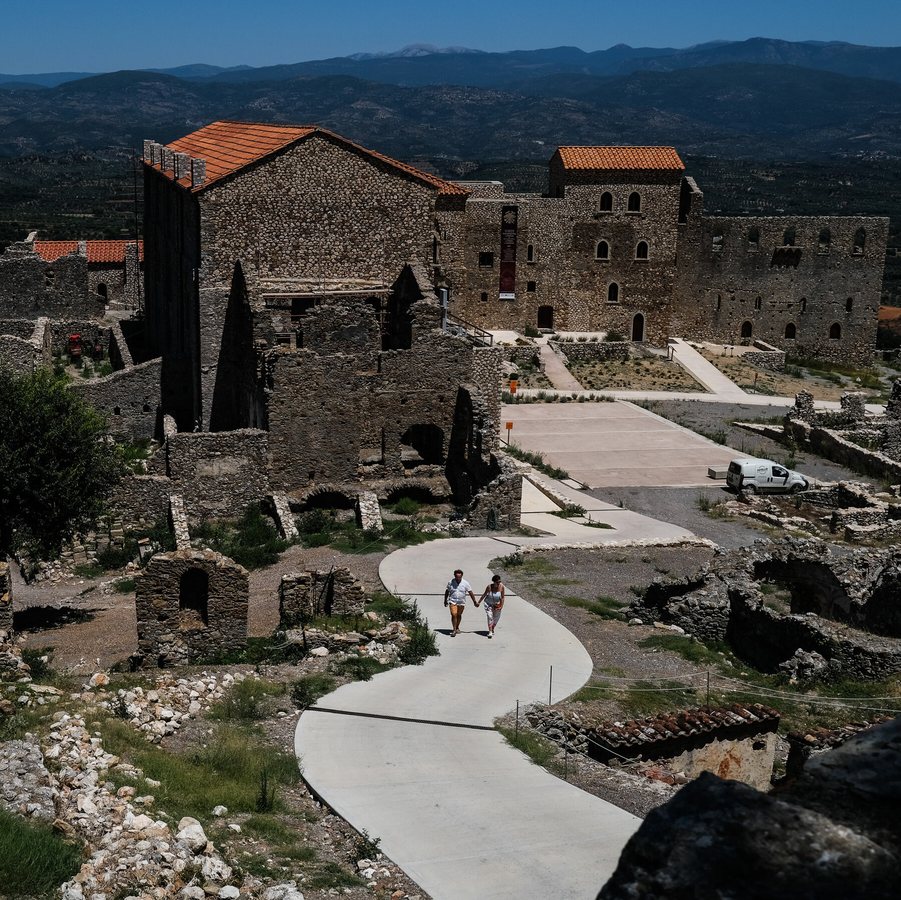
Greece is testing a new strategy to protect its ancient ruins from the growing threat of wildfires: building emergency access roads directly into archaeological sites. The approach is being piloted at Mystras, a fortified medieval town in the southern Peloponnese that sits on a forested hillside and ranks among the country's most visited cultural landmarks.
The newly constructed road at Mystras, completed in July, is designed to give firefighting vehicles rapid entry to the site's upper reaches, where narrow pedestrian paths and stone staircases have long made emergency response difficult. The road is part of a broader national effort to adapt heritage management to a hotter, drier climate that has turned Greece's summers into a prolonged fire season.
Wildfires have repeatedly threatened archaeological sites across the country in recent years. In 2021, flames came within meters of the ancient theater at Epidaurus, and in 2023, a major blaze on Rhodes forced the evacuation of thousands of tourists while firefighters worked to protect the island's medieval old town. The fire at Mystras itself, which burned through surrounding pine forest in 2022, prompted the current intervention.
The challenge is balancing fire safety with the preservation of archaeological integrity. Conservation experts argue that any modification to a protected site must be reversible and visually unobtrusive, while firefighting officials insist that without better access, they cannot reach the heart of a site before flames do. The road at Mystras was therefore built with a compacted earth surface rather than asphalt, and its route was chosen to avoid known buried structures.
Greek authorities have also begun clearing vegetation in buffer zones around several sites, creating firebreaks that can slow the spread of flames. At Delphi, home to the ancient oracle and a UNESCO World Heritage site, teams have thinned dry brush along the slopes above the sanctuary. Similar work is planned at Olympia, where the original Olympic Games were held, and at the palace of Knossos on Crete.
The initiative reflects a wider recognition that climate change is reshaping the risks faced by cultural heritage. Southern Europe, in particular, is experiencing longer droughts and more intense heat waves, conditions that make wildfires more frequent and harder to contain. For Greece, which depends heavily on cultural tourism, the stakes are both historical and economic.
Archaeologists are also studying how past societies dealt with fire. Excavations at several sites have revealed layers of ash and charred timber, evidence that ancient Greeks and Romans faced similar threats and developed their own fire prevention methods, including stone walls and cleared perimeters. Modern planners are drawing on those lessons as they design new protective measures.
The emergency road at Mystras is not a permanent solution, officials acknowledge. It is a practical tool for a crisis that is expected to recur. But it marks a shift in how Greece approaches the relationship between its ancient past and its changing present: rather than treating ruins as static monuments to be shielded from the modern world, the country is now integrating them into contemporary disaster response systems.
As fire seasons grow longer and more severe, other nations with vulnerable heritage sites are watching the Greek experiment closely. Italy, Spain, and Turkey have all experienced fires near major archaeological zones in recent years, and each is exploring similar access and vegetation management strategies. The outcome at Mystras could offer a model for protecting the world's irreplaceable cultural landmarks from an increasingly fiery future.
98