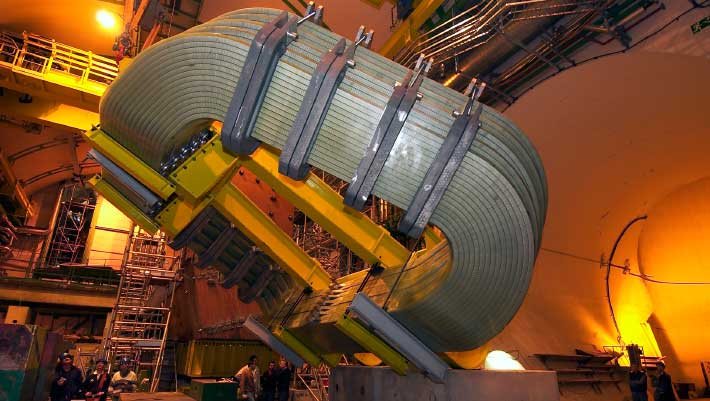
Physicists with the LHCb Collaboration at CERN's Large Hadron Collider have announced evidence for an extremely rare particle decay that researchers have pursued for more than four decades. The result agrees with the Standard Model of particle physics, the framework that describes the known fundamental particles and the forces acting between them.
Particle decays are processes in which an unstable particle transforms into lighter particles. Some of these transitions are so uncommon that they occur only a handful of times among enormous numbers of collisions, which is why detecting them requires large datasets and highly sensitive detectors. The LHCb experiment is designed to study particles containing beauty and charm quarks, and its measurements are used to test whether the Standard Model's predictions hold at very fine levels of precision.
Because the decay is so rare, its signal is faint against the background noise produced by many other processes in the collider. The team reports evidence rather than a definitive observation, meaning it has identified an excess of candidate events that is unlikely to be explained by chance alone, while the statistical significance remains below the threshold physicists conventionally require to claim a discovery. Researchers usually treat such results as a step toward more data-intensive measurements that can confirm or refine the picture.
The agreement with theoretical predictions matters for the field. The Standard Model has been remarkably successful, yet physicists continue to search for deviations that could signal new physics, such as particles or interactions not yet included in the framework. A measurement that matches expectations narrows the range of possible explanations for any discrepancy and helps calibrate the tools used in future searches.
The work also shows the Large Hadron Collider's role as a general-purpose testing ground. Beyond the hunt for new particles, its experiments systematically measure rare processes to probe the limits of current theory. Each refinement adds constraints that theorists must account for, and it keeps the community focused on subtle effects that may only emerge from very large samples of data.
The announcement underlines a broader pattern in high-energy physics, where decades-old questions about rare processes are answered gradually, through successive generations of detectors and analyses. Experimental progress in this area depends on accumulating collision data over long periods, so a result that has been pursued for more than forty years reflects both the difficulty of the measurement and the steady improvement of the instruments used to make it.
Source: sci.news
16