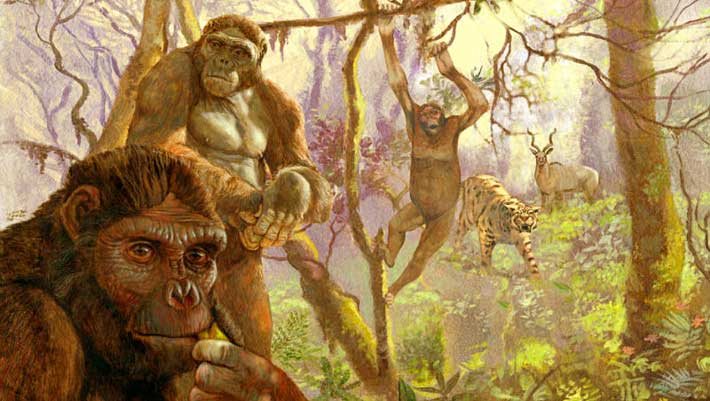
An enduring question in paleoanthropology is what kind of foot the last common ancestor of humans and chimpanzees possessed. Did it resemble the specialized foot of modern apes, adapted for climbing straight up tree trunks, or was it more like the generalized foot of a monkey, less suited to vertical climbing? New research suggests the latter may be the case.
The study, published in the journal Science Advances, analyzed the foot bones of modern primates and compared them with fossil evidence. The researchers found that the last common ancestor likely had a foot that was more monkey-like, with a grasping big toe and flexible ankle, rather than the stiff, specialized foot seen in chimpanzees and gorillas today.
This finding challenges the long-held assumption that the ancestor of humans and chimpanzees was already adapted for vertical climbing. Instead, it suggests that the ability to climb trees efficiently may have evolved independently in the lineages leading to modern apes and humans, or that early hominins retained a more generalized foot structure for a longer period.
The study's lead author, a paleoanthropologist at the University of California, Davis, explained that the findings have significant implications for understanding how early humans moved and adapted to their environment. "If the last common ancestor had a monkey-like foot, it may have been less efficient at climbing vertical trunks but more versatile in other types of locomotion," the researcher said.
The debate over the foot structure of the last common ancestor is part of a larger discussion about the origins of bipedalism. Some scientists argue that early hominins evolved from a climbing ancestor, while others propose that they descended from a more quadrupedal, monkey-like ancestor. This new evidence supports the latter view, suggesting that the transition to bipedalism may have occurred from a more generalized primate ancestor.
The researchers used advanced imaging techniques to analyze the internal structure of fossil foot bones, allowing them to infer the likely function of the foot. They compared these fossils with the feet of modern primates, including monkeys, apes, and humans, to determine which features were likely present in the last common ancestor.
While the study provides compelling evidence, the authors acknowledge that the fossil record for the last common ancestor is still sparse. More fossils from the critical period between 8 and 6 million years ago are needed to confirm these findings. Nevertheless, the study offers a new perspective on the evolutionary history of human locomotion.
The findings also have broader implications for understanding the ecological pressures that shaped early human evolution. If the last common ancestor was more monkey-like, it may have lived in a variety of habitats, from forests to woodlands, rather than being restricted to dense forests. This could have influenced the development of bipedalism as a response to changing environments.
As research continues, the question of what our ancient ancestors' feet looked like remains a key piece of the puzzle in understanding human origins. This study adds a new chapter to that story, suggesting that the path to bipedalism was more complex than previously thought.
134