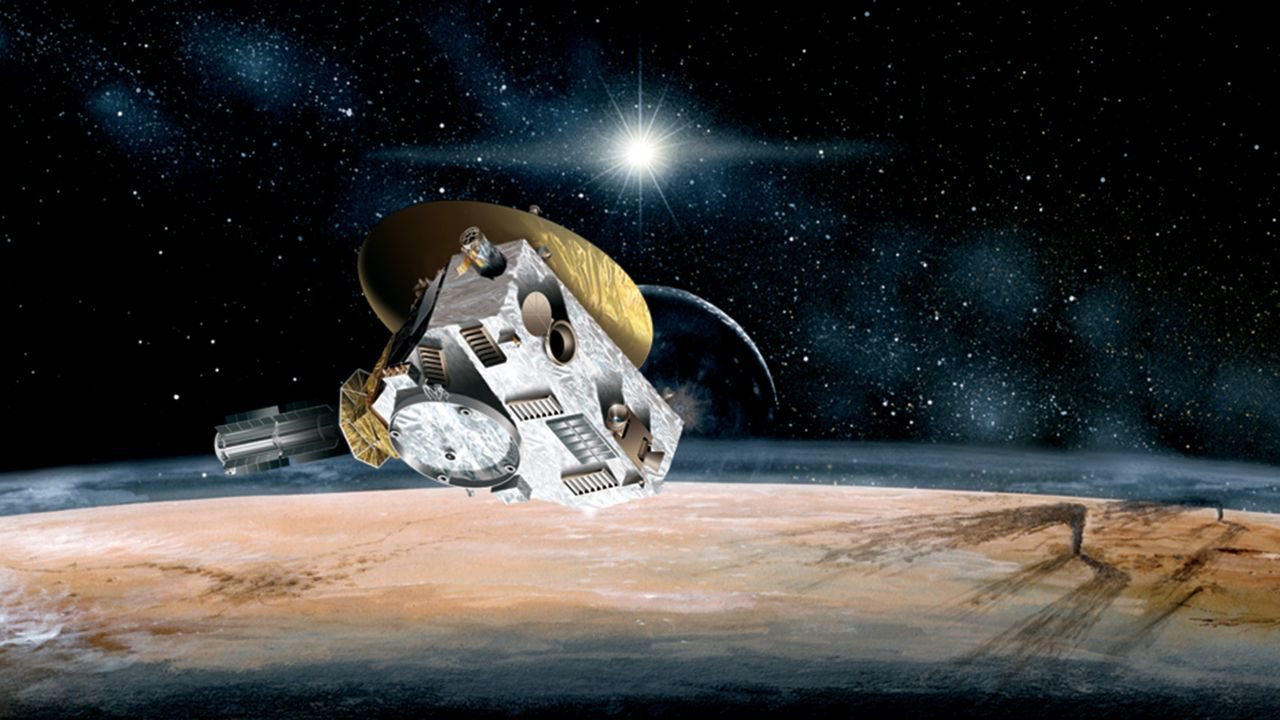
NASA's New Horizons spacecraft, famous for its historic flyby of Pluto in 2015, has awakened from a yearlong hibernation to embark on a new phase of exploration in the outer reaches of the solar system. The probe, now operating in the Kuiper Belt, is set to conduct unprecedented scientific observations that could reshape our understanding of the distant region beyond Neptune.
The spacecraft emerged from its deep sleep on schedule, sending a signal back to mission controllers at the Johns Hopkins Applied Physics Laboratory in Maryland. This wake-up call marks the beginning of an extended mission that will focus on studying the Kuiper Belt, a vast ring of icy bodies and debris that orbits the Sun beyond Neptune. New Horizons is currently the only spacecraft operating in this remote area, giving scientists a unique opportunity to gather data that cannot be obtained from Earth or from telescopes.
During its hibernation, New Horizons traveled hundreds of millions of miles farther into the solar system, maintaining its trajectory and systems in a low-power state to conserve energy. The spacecraft's health and systems have been verified as nominal, and it is now ready to execute a series of observations that will include studies of Kuiper Belt objects, measurements of the solar wind and charged particles, and investigations of the dust environment in this outer region.
One of the key goals of this new mission phase is to observe as many Kuiper Belt objects as possible, building on the data collected during the flyby of Arrokoth, a contact binary object that New Horizons visited in 2019. That encounter provided the first close-up look at a pristine building block of the solar system, revealing details about the early formation of planets. The spacecraft will now use its suite of instruments, including cameras, spectrometers, and particle detectors, to study the composition, surface properties, and orbits of additional objects in the belt.
Scientists are particularly interested in the Kuiper Belt because it contains remnants from the solar system's formation more than 4.6 billion years ago. These icy bodies have remained largely unchanged for eons, offering a window into the conditions that existed when the planets were taking shape. By analyzing the data New Horizons collects, researchers hope to gain insights into the chemical and physical processes that governed the early solar system.
The spacecraft will also continue to measure the environment of the outer heliosphere, the bubble of charged particles and magnetic fields that the Sun creates around itself. New Horizons is one of only two spacecraft, along with the Voyager probes, that are exploring this distant frontier. Its observations of the solar wind, cosmic rays, and interstellar dust will complement data from Voyager and help scientists understand the boundary between the solar system and interstellar space.
New Horizons' extended mission comes at a time when interest in the outer solar system is growing. The discovery of numerous Kuiper Belt objects, including some that may be large enough to be considered dwarf planets, has spurred calls for further exploration. The spacecraft's unique position allows it to observe these objects from angles and distances that are impossible for Earth-based telescopes, providing a more complete picture of their characteristics.
Mission planners have designed a series of observation campaigns that will take advantage of New Horizons' trajectory and capabilities. The spacecraft will perform long-range imaging of selected Kuiper Belt objects, measure their light curves to determine rotation rates and shapes, and search for satellites or rings around them. It will also conduct spectroscopy to identify surface materials such as water ice, methane, and organic compounds.
In addition to its scientific objectives, the extended mission serves as a technological demonstration. New Horizons has operated far longer than its original design life, and its continued functionality provides valuable data on how spacecraft systems perform in the harsh environment of the outer solar system. The lessons learned from its operations could inform the design of future missions to the Kuiper Belt and beyond.
The spacecraft's awakening has been met with enthusiasm by the scientific community. Researchers who have worked on the mission for years are eager to see what new discoveries await. The Kuiper Belt is still largely unexplored, and every observation New Horizons makes has the potential to reveal something unexpected.
New Horizons is expected to continue its observations for several more years, depending on its power supply and the health of its instruments. The spacecraft carries a radioisotope thermoelectric generator that converts heat from plutonium decay into electricity, and it is projected to have enough power to operate until the late 2030s. This gives scientists a long window to gather data from a region of the solar system that remains one of the least understood.
As New Horizons begins this new chapter, it carries with it the legacy of its predecessor missions and the hopes of planetary scientists around the world. The spacecraft has already rewritten textbooks with its discoveries at Pluto and Arrokoth, and its ongoing work in the Kuiper Belt promises to continue that tradition of exploration and discovery.