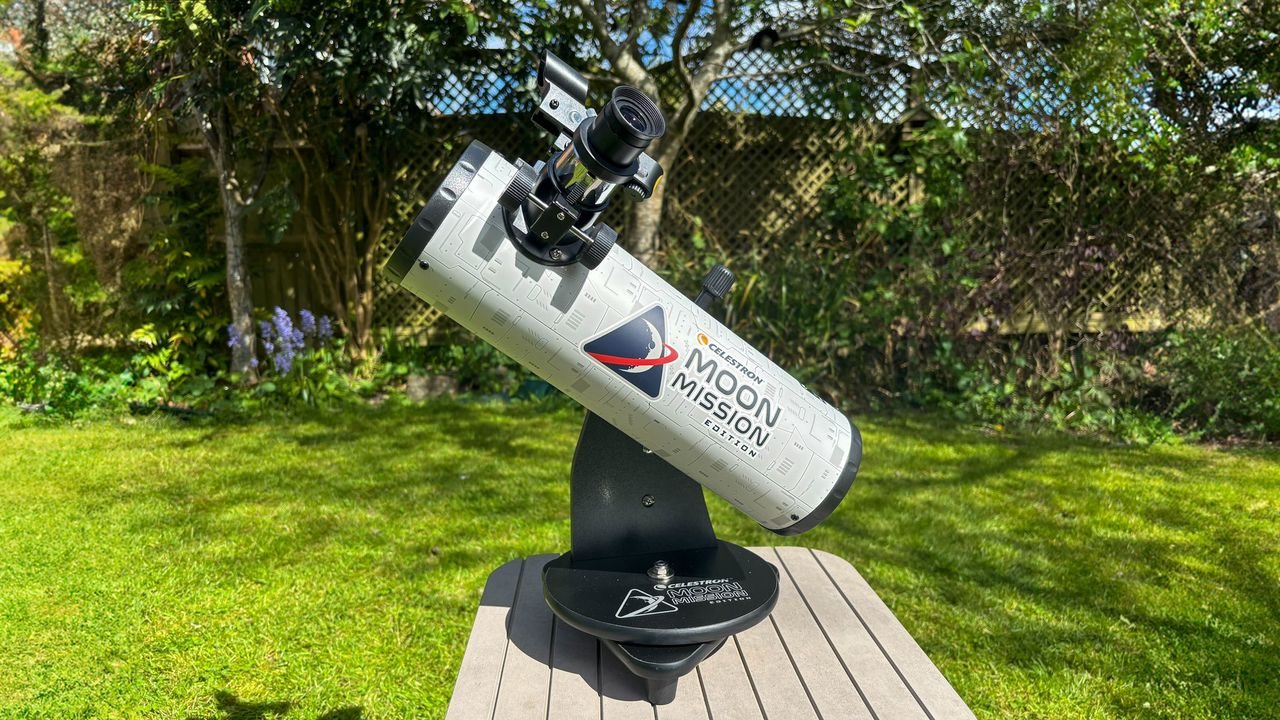
Celestron's Moon Mission 100mm tabletop Dobsonian is a compact reflector telescope designed for beginning skywatchers who want a straightforward way to observe the Moon and brighter planets. Built around a 100mm primary mirror and a small tabletop mount, it tries to solve the two biggest problems casual observers often face: bulky equipment and complicated setup.
The telescope is a Newtonian reflector with a 100mm aperture, giving it significantly more light-collecting ability than small beginner refractors in the same price range. The optical tube is paired with a short-focus design, which keeps the instrument compact while providing wide, low-power fields. A tabletop Dobsonian mount uses a simple alt-azimuth motion, meaning users push the tube gently up and down and side to side to follow targets as Earth rotates.
For novices, the tabletop format is part of the appeal. There is no tripod to assemble, no counterweights to balance, and no goto electronics to program. The base is small enough to sit on a sturdy table, picnic bench, or tailgate, and the optical tube lifts off quickly for storage. Setup, in principle, takes only a few minutes: place the base on a stable surface, set the tube in its cradle, insert an eyepiece, and adjust the included finder.
With a 100mm mirror, the telescope is well suited to the Moon, which the «Moon Mission» branding emphasizes. At low magnification, the full lunar disk fits easily in the field of view; at higher magnification, users can examine the terminator, where craters and mountain ranges cast long shadows. The same aperture also makes the telescope capable of showing the phases of Venus, the bands of Jupiter, and the rings of Saturn under reasonably dark skies, although these objects will appear small at the shortest focal lengths.
The kit takes a beginner-focused approach by pairing the telescope with accessories intended for immediate observing. A low-power eyepiece delivers a generous field of view for locating targets, while a higher-power eyepiece offers a closer look at lunar details. A finder helps users aim the telescope, and the package is oriented around giving a first-time observer a complete, ready-to-use lunar setup rather than a bare optical tube.
Because the telescope relies on manual aiming, users need to develop basic sky navigation skills. There are no motors or computerized hand controllers, so objects slowly drift out of the eyepiece as the Earth rotates. This is not a downside for many beginners; in fact, learning to nudge the telescope by hand is part of the classic Dobsonian experience. But observers expecting an automated «push a button and it finds the Moon» instrument will need to adjust their expectations.
The tabletop design also means the observer must supply a surface of appropriate height. Sitting on the ground or kneeling can become uncomfortable, especially during longer sessions. The telescope works best when placed on a sturdy table, and some users may want a small stool or chair so the eyepiece is at a comfortable height. Because the base must be level and stable, a wobbly table can affect image stability at higher magnification.
As with any reflector, maintenance is a consideration. The mirror surfaces are open to dust and need occasional cleaning, and the optical alignment, or collimation, may need checking after transport. Many tabletop Dobsonians are forgiving enough for casual use, but owners should be prepared to learn a few basic maintenance routines. Collimation tools are inexpensive, and the rewards are sharper images.
The Moon Mission 100mm sits in the middle of a crowded entry-level telescope market. Its main competitors include small refractors on tripods and compact Maksutov-Cassegrain telescopes, many of which offer some kind of computerized guidance. For skywatchers who prefer simplicity and value aperture for the price, a tabletop Dobsonian is often the more sensible choice. The 100mm mirror collects enough light to show real detail on the Moon and bright planets without requiring a large vehicle for transport.
Celestron's naming also highlights the intended audience. The «Moon Mission» theme wraps the telescope in a clear observing goal: learn the Moon's craters, seas, and mountain ranges. It is an approachable starting point, especially for families and children, because the Moon is easy to find, bright enough to be seen from cities, and endlessly detailed with even modest aperture.
For prospective buyers, the deciding question is between convenience and capability. A computerized small telescope can find objects automatically, but it often comes with a smaller aperture and more complexity. The Moon Mission 100mm tabletop Dobsonian takes the opposite approach, asking the user to aim manually while providing relatively generous light grasp in a package small enough to carry outside in one trip.
Overall, the telescope is best seen as an entry door to serious skywatching rather than a flagship instrument. It is light, compact, and forgiving, with optics that reward patient observers. It will not replace a large telescope on an equatorial mount, but it does not try to. Instead, it promises that a beginner can be outside with a real astronomical telescope within minutes of opening the box, pointed at the most familiar and striking object in the night sky.