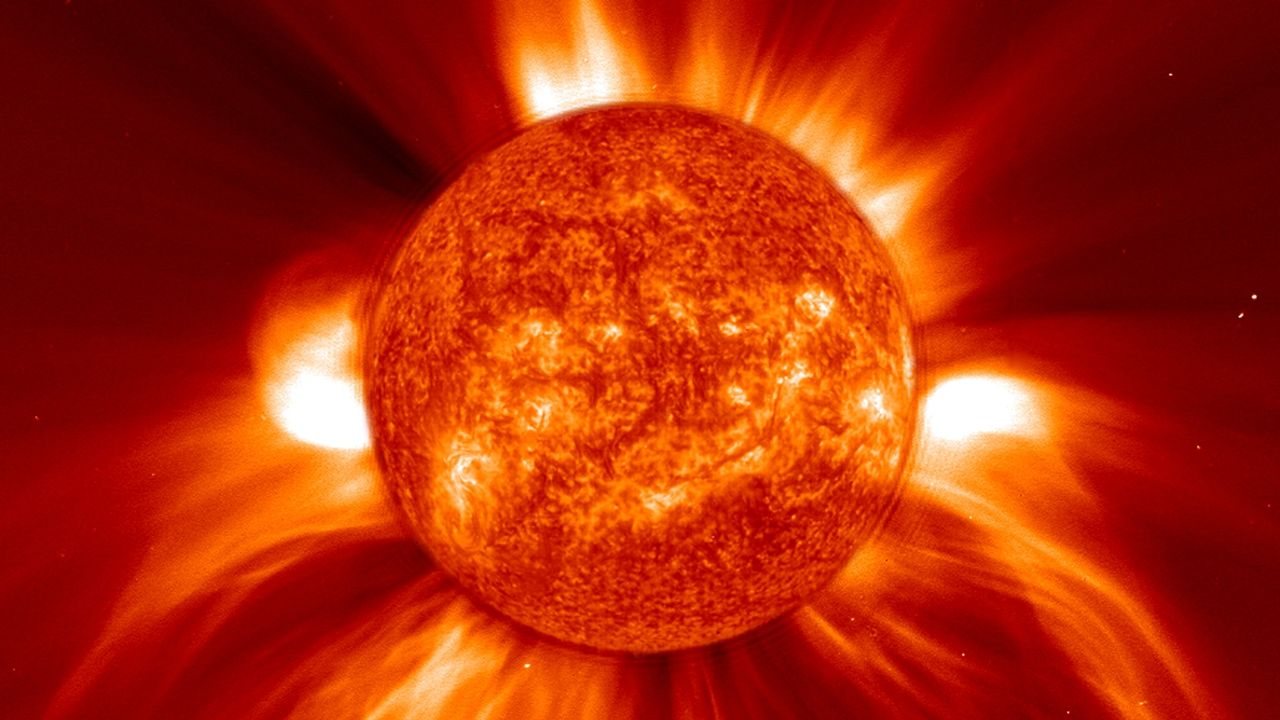
A coordinated fleet of 17 spacecraft has given scientists an unprecedented look at solar eruptions, revealing that these powerful blasts of plasma are far more complex and varied in their structure than earlier models suggested. The multi-spacecraft campaign, which combined observations from satellites positioned at different points in the solar system, captured the evolution of several coronal mass ejections as they traveled from the Sun into interplanetary space.
The findings challenge a long-held assumption that solar eruptions expand in a relatively uniform, self-similar way as they move away from the Sun. Instead, the new data show that the shape and internal structure of these eruptions can change significantly depending on their speed, the surrounding solar wind, and interactions with other solar phenomena. Some eruptions were observed to stretch, compress, or even rotate in ways that had not been clearly documented before.
Coronal mass ejections are among the most energetic events in the solar system, hurling billions of tons of magnetized plasma into space at speeds that can exceed a thousand kilometers per second. When these clouds of charged particles reach Earth, they can trigger geomagnetic storms that disrupt satellites, power grids, and radio communications, and pose risks to astronauts. Understanding their precise structure is therefore not just an academic exercise but a practical concern for space weather forecasting.
The 17 spacecraft involved in the campaign included solar observatories near Earth, such as the Solar and Heliospheric Observatory and the Solar Dynamics Observatory, as well as the twin STEREO spacecraft, which observe the Sun from different vantage points. The fleet also drew on planetary missions and other probes located at various distances from the Sun, allowing scientists to track the same eruption at multiple stages of its journey. This multi-point perspective is what made the discovery possible, because a single spacecraft can only sample the eruption along one line of sight.
By combining images and in-situ measurements from these widely separated platforms, the research team was able to reconstruct the three-dimensional structure of the eruptions in detail. The analysis revealed that the classic picture of a simple, expanding bubble of plasma is an oversimplification. In reality, the eruptions often develop complex fronts, with some regions moving faster than others, and their magnetic field configurations can become twisted and distorted as they interact with the ambient solar wind.
The results have implications for improving space weather models, which currently rely on simplified assumptions about eruption geometry to predict when and how strongly a coronal mass ejection will affect Earth. More accurate models, informed by the new observations, could lead to earlier and more reliable warnings of geomagnetic storms, giving operators of satellites and power grids more time to take protective measures.
The study also underscores the value of coordinated, multi-spacecraft observation campaigns in heliophysics. While individual missions provide valuable data, the full picture of solar eruptions emerges only when many instruments work together, each contributing a different piece of the puzzle. The success of this campaign is expected to encourage further collaborative efforts, especially as new missions with advanced capabilities come online in the coming years.
The research was published in a peer-reviewed scientific journal and represents a significant step forward in understanding the fundamental physics of solar eruptions. As the Sun approaches the peak of its roughly 11-year activity cycle, such knowledge will become increasingly important for anticipating the effects of space weather on modern technology and infrastructure.
111