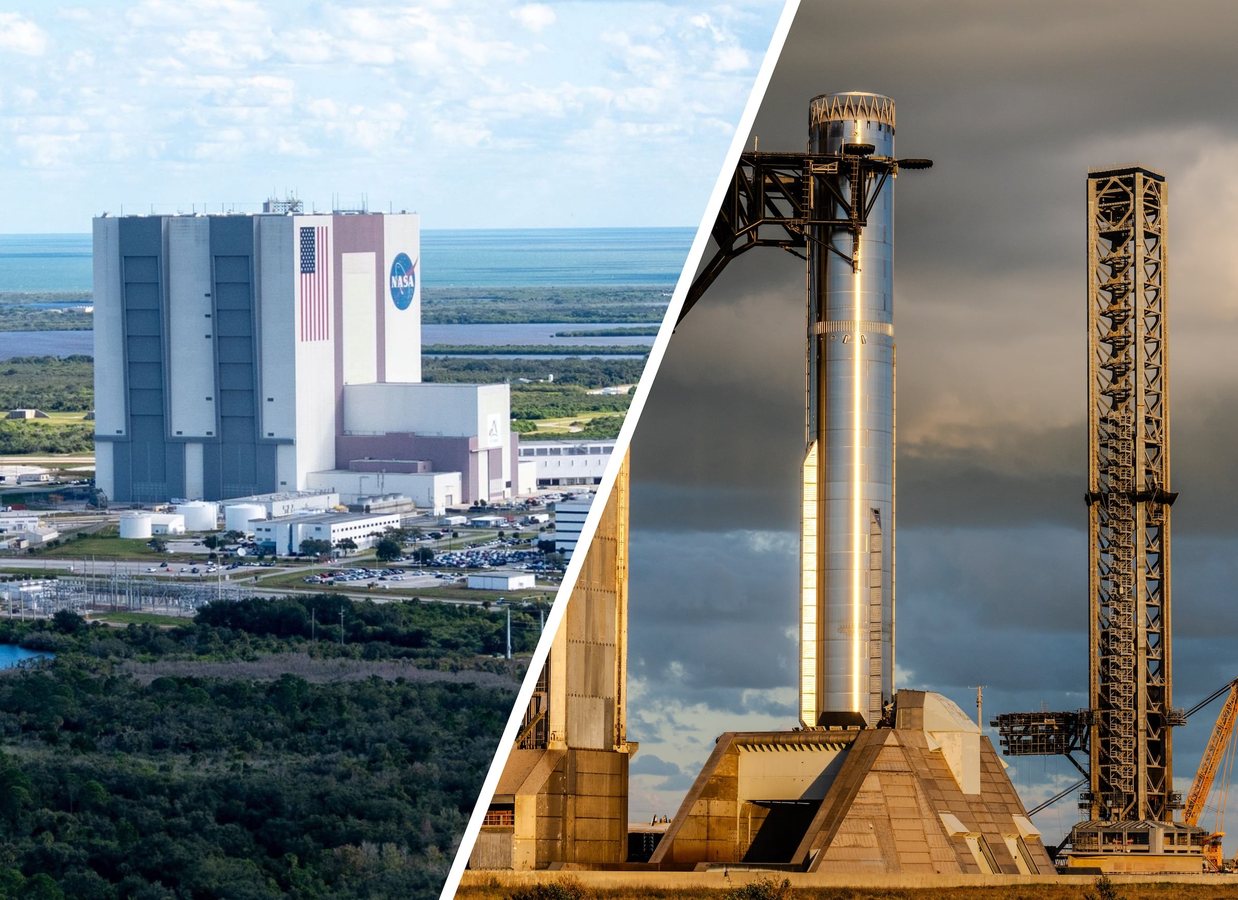
Launch infrastructure is often the slowest part of bringing a new rocket to flight. Launch pads, vehicle integration facilities and support systems all have to be built before a first launch can take place. A comparison of past construction timelines, from NASA's Kennedy Space Center to the Cape Canaveral launch complexes, offers a useful benchmark for estimating how long SpaceX's recently announced Starbase site in Louisiana may need before it can support its planned first launch in roughly three years.
NASA built the Kennedy Space Center in about five and a half years, Cape Canaveral Space Force Station took 14 months to develop, and SpaceX's Starbase in Texas has taken about four and a half years so far. Construction at Kennedy began in March 1962 as the Launch Operations Center. The site was renamed Kennedy Space Center in November 1963, following the assassination of President John F. Kennedy. It was conceived partly as a response to the Soviet Union's Baikonur Cosmodrome in Kazakhstan, and its builders worked quickly toward the goal of landing crews on the Moon before the end of the 1960s.
Construction of the Vehicle Assembly Building began in August 1963 and took about three years, finishing in 1966 with four high bays for assembling the Saturn family of rockets. Launch Complex 39A was started in November 1963 and completed in September 1965 after 22 months. Launch Complex 39B began in December 1964 and was completed in April 1967, after 28 months. Teams then spent another 26 months outfitting LC-39A for Apollo 4, which launched on November 9, 1967. LC-39B saw its first launch 25 months after completion, with Apollo 10 on May 18, 1969. In total, LC-39A took four years to reach launch readiness and LC-39B just under four and a half years. For NASA in the 1960s, speed was essential, and the agency completed the major infrastructure for the Apollo program in about four years.
Cape Canaveral Space Force Station began as a military facility known as the Cape Canaveral Launch Area. Early U.S. rockets required few established facilities. The first missile launch from the site, Bumper 8, took place in July 1950, just two months after construction began in May 1950. Later pads for early crewed launches took longer. Launch Complex 5 was started in 1954 and first launched in July 1956, while Launch Complex 14 broke ground in January 1956 and saw its first launch in June 1957. Space Launch Complex 40 was built in the 1960s for Titan III launches and was leased by SpaceX in April 2007. Refurbishment for the Falcon 9 began in 2008, and the rocket flew its maiden mission from the pad in June 2010. The AMOS-6 anomaly in September 2016 severely damaged the pad, which required 15 months of repairs before returning to service in December 2017.
Launch Complex 36 was constructed in the early 1960s to support Atlas-Centaur launches and hosted 145 launches before going unused from 2005 to 2015. Blue Origin leased the complex in 2015 and broke ground on refurbishment of LC-36A in June 2016. Its New Glenn rocket flew its maiden mission in January 2025, and an explosion during testing on May 28, 2026, severely damaged the pad. Repairs began soon after, and the company is working to return New Glenn to flight before the end of 2026. Blue Origin has also announced plans to refurbish the adjacent LC-36B for the larger New Glenn 9×4 variant, though no construction timeline has been discussed.
Launch Complex 14, located between SLC-40 and LC-36, was built in the late 1950s as the first operational site for early Atlas rockets. It hosted all four orbital missions of the Mercury program, including Friendship 7, which made John Glenn the first American to orbit Earth. The site continued to see Atlas-Agena launches until November 1966, when it was decommissioned. Stoke Space acquired a lease on the site in March 2023 and began refurbishment in October 2024. Taken together, these examples show that early launch sites could be built in months, while complex heavy-lift pads required several years. The comparisons suggest that the timeline for Starbase Louisiana will depend heavily on the scale of its facilities and the infrastructure required for its planned vehicles.
10