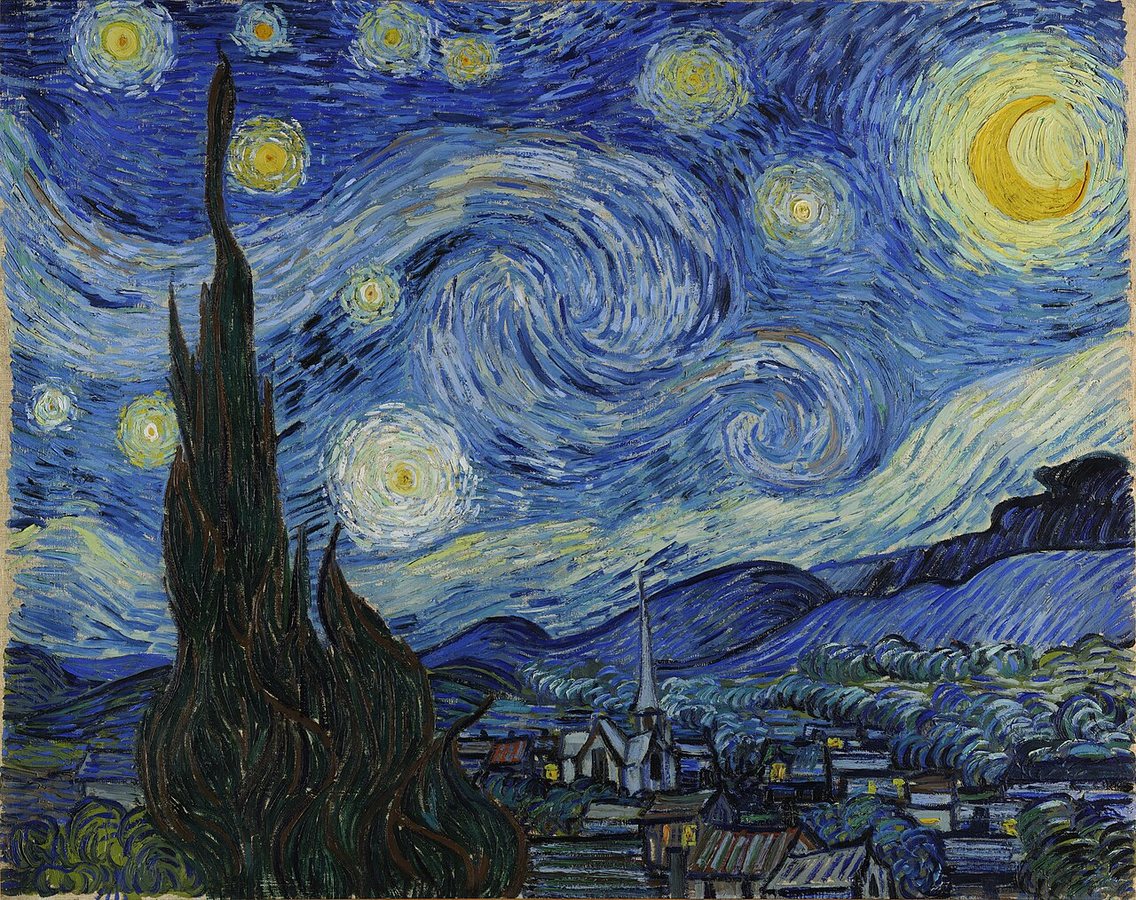
South Korean astronomers say the stars in the background of Vincent van Gogh’s painting The Starry Night match the real pre-dawn sky over Saint-Rémy, the town where the artist made the work, in both observation and shape. Their analysis places the painting’s likely creation on July 22, 1889. The team says the finding confirms that Van Gogh drew on real stellar observations, and that the approach could offer more accurate dating for his other artworks.
The research was carried out by astronomers at SLLAB, a South Korean space-science company, together with colleagues from the School of Space Research at Kyung Hee University. Art historians have typically dated the painting using a letter Van Gogh wrote to his brother Theo around June 18, 1889. Astronomers, however, have long noted that the waning gibbous moon in that period does not match the slender crescent depicted in the painting. Many observers have also pointed to a star cluster in the picture that resembles the Hyades in Taurus, suggesting a different date. Earlier attempts to date the sky, in 1984 and 1986, reached conflicting conclusions, and the researchers said neither displaced the prevailing religious and symbolic interpretations of the painting.
Elijah Jeong-hyun Kim, CEO of SLLAB and a Ph.D. candidate at Kyung Hee University’s School of Space Research, said the conflicting dates and the familiar star cluster prompted him to investigate. After years of observing the night sky, he and his colleagues concluded that Aries, which earlier studies had proposed as the source of the painting’s stars, was an unlikely inspiration. “To an observational astronomer, the cluster of stars in The Starry Night is the Hyades in Taurus,” Kim said. “The moment I read the earlier studies explaining it as Aries, I heard the painting calling to me.”
When the team examined the star patterns, it suspected that a date when the Hyades rose in the east alongside Venus would fit better, and that the shape of the crescent moon matched a different date more closely. Art historians had long assumed that date fell within the timeline of one of Van Gogh’s seizures, which made it an unlikely match. To test the idea, the researchers gathered new astronomical and historical data and made two separate field trips to France. They analyzed weather records containing remarks about cicadas in the original French and Dutch letters, which suggested that Van Gogh’s seizure began in late July rather than earlier in the summer.
In Arles, the team used photographs taken from the site to verify the viewpoint Van Gogh had used in Starry Night over the Rhône (1888). They then visited the exact spot at Saint-Rémy where Van Gogh drew the landscape beneath The Starry Night, and reconstructed the site astronomically. According to the team’s Procrustes shape analysis, the five central stars in The Starry Night matched the Hyades. The researchers said their findings were an even closer match to a pen drawing Van Gogh made after the painting. On that basis, they say the work essentially confirms that Van Gogh painted The Starry Night on July 22.
The team said the result indicates that the painting’s sky was not created purely from imagination, but is likely based on actual observation. Kim said the researchers hope the work prompts a “renewed, multidisciplinary look at the sequence and working methods of the Saint-Rémy paintings,” as well as at the artist’s movements in the summer of 1889. Applying the same method to the stars in Café Terrace at Night (1888), the team found that the sky in that work may be the Summer Triangle. “Our conversation with Van Gogh’s other skies is still ongoing,” Kim said, adding that the team plans to “tell those stories one by one.”
12