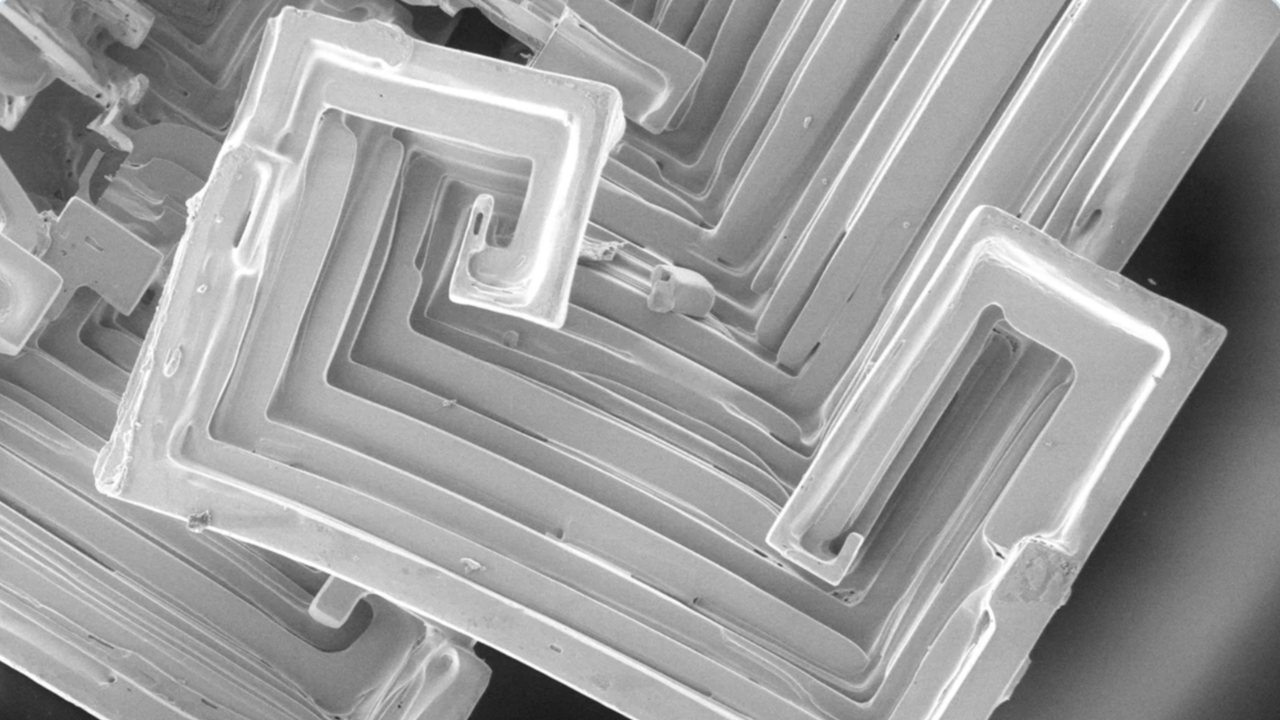
A NASA astronaut aboard the International Space Station has shared an image of an extraordinary 'hopper' crystal, a structure that appears to defy typical crystal growth patterns in the microgravity environment of space. The photograph, released by the space agency, shows a cube-shaped crystal with stepped, terraced edges, resembling a miniature staircase or a hopper—a term used in crystallography to describe crystals that grow with hollow, stepped faces. This unusual formation has sparked interest among scientists, who are analyzing the phenomenon to better understand how materials behave in space and to advance technologies for future missions.
The crystal, which formed spontaneously during an experiment on the ISS, is composed of a zinc-based compound, according to preliminary analyses. Hopper crystals are rare on Earth, typically occurring when a crystal grows faster at its edges than at its center, creating a stepped or hopper-like appearance. In microgravity, where gravity-driven convection and sedimentation are minimized, crystal growth processes can differ significantly from those on Earth, leading to unexpected structures. The ISS National Laboratory, which oversees many of the experiments aboard the station, has noted that such formations provide valuable data for improving crystal growth techniques for semiconductors, pharmaceuticals, and other high-tech materials.
The image was captured by NASA astronaut Matthew Dominick, who has been documenting various experiments and daily life on the ISS. Dominick, a flight engineer for Expedition 71, posted the photograph on social media, describing the crystal as 'impossible-looking' and highlighting the serendipitous nature of the discovery. The crystal was observed in a specialized furnace used for materials science research, where samples are heated and cooled under controlled conditions to study phase transitions and crystal formation. Researchers on the ground are now working to replicate the conditions that led to the hopper crystal, aiming to unlock its potential applications.
This discovery adds to a growing body of research on crystal growth in microgravity, which has implications for both space exploration and terrestrial industries. For instance, more uniform crystals grown in space could lead to better drug formulations, more efficient solar cells, and advanced electronics. The ISS has long served as a laboratory for such studies, with experiments like the Materials International Space Station Experiment (MISSE) and the Advanced Colloids Experiment (ACE) providing insights into how materials self-assemble without the influence of gravity. The hopper crystal, however, stands out due to its distinct morphology, which may offer clues about the role of surface tension and diffusion in crystal formation.
Beyond its scientific value, the image has captivated the public, illustrating the beauty and complexity of natural processes in space. The crystal's stepped structure, with its sharp angles and translucent layers, resembles a tiny architectural model, prompting comparisons to futuristic buildings or alien artifacts. NASA officials have emphasized that such findings underscore the importance of continued investment in microgravity research, as they often lead to unexpected breakthroughs. The agency is planning follow-up experiments to characterize the crystal's properties more thoroughly, including its electrical and thermal conductivity, which could inform the design of new materials for spacecraft and habitats.
The hopper crystal also highlights the collaborative nature of space research, involving astronauts, ground-based scientists, and international partners. The ISS, a joint project of NASA, Roscosmos, JAXA, ESA, and CSA, has hosted thousands of experiments since its first module launched in 1998. Materials science remains a key focus, with researchers from around the world using the station's unique environment to test theories and develop new technologies. The latest finding is expected to be published in a peer-reviewed journal after further analysis, contributing to the broader understanding of crystal growth dynamics.
In the meantime, the image serves as a reminder of the wonders that emerge from exploration. As Dominick noted in his post, 'Sometimes the most interesting discoveries are the ones you don't expect.' The hopper crystal, with its improbable form, is a testament to the ongoing quest for knowledge in the cosmos, where even a small sample can reveal profound insights into the laws of nature.