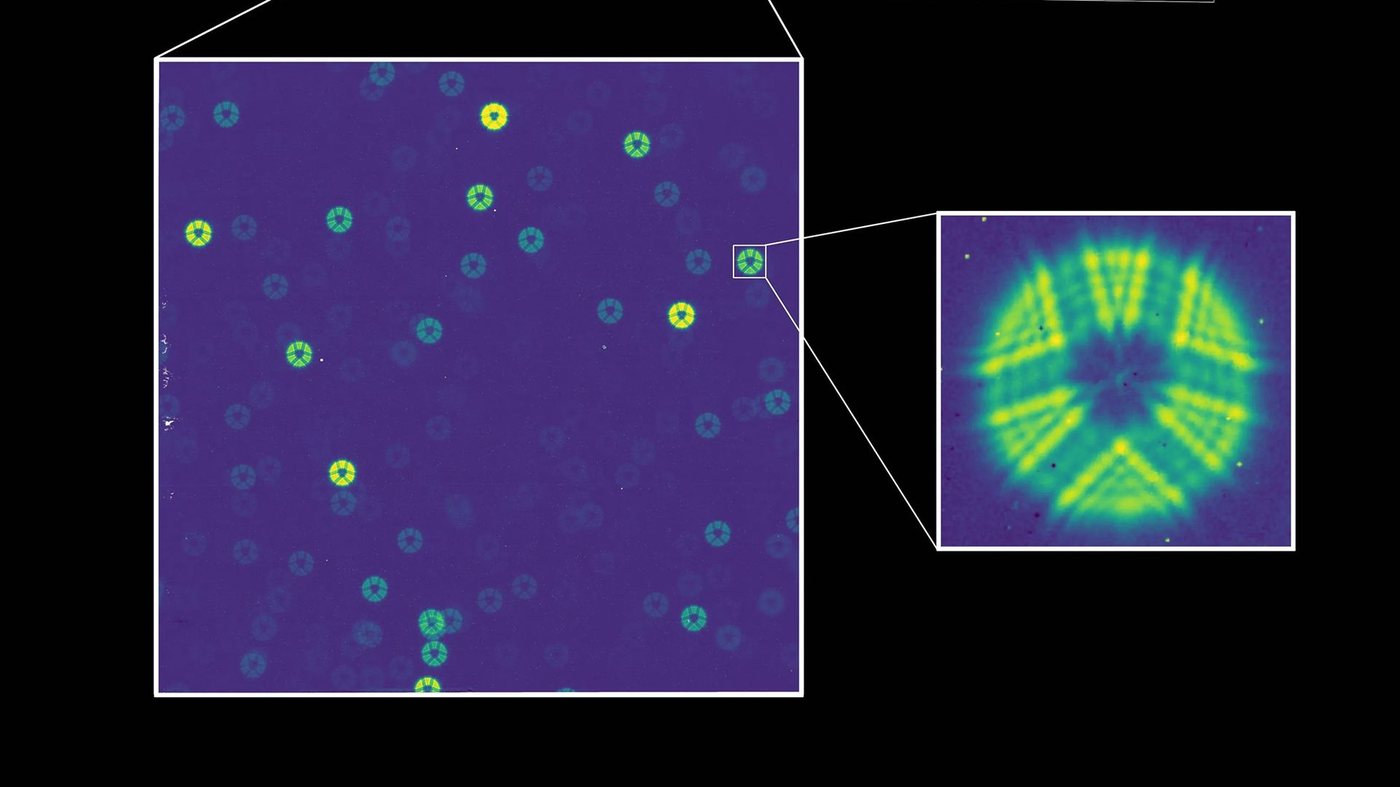
NASA's Nancy Grace Roman Space Telescope has produced its first test image, a milestone that brings the mission closer to launch and to what agency officials describe as groundbreaking science. The image shows stars rendered in a vivid neon-green color, a result of the telescope's infrared detectors and the way the test data were processed.
The Roman telescope is designed to survey the universe in infrared light, a capability that requires detectors sensitive to wavelengths invisible to the human eye. In the test image, those detectors captured starlight that was then assigned a green color for visual display. The striking hue is not how the stars would appear to a human observer but a standard technique for representing infrared data.
The successful test image confirms that the telescope's optical system and detectors are functioning as intended. It is an early step in a series of checks that will continue as the observatory is prepared for launch. NASA has not yet announced a specific launch date, but the mission remains on track for the mid-2020s.
Roman's primary scientific goals include studying dark energy, the mysterious force accelerating the expansion of the universe, and searching for exoplanets using gravitational microlensing. Its wide field of view will allow it to survey large areas of the sky far faster than previous space telescopes, providing a wealth of data for astronomers.
The telescope is named after Nancy Grace Roman, NASA's first chief of astronomy and a key advocate for space-based observatories. Her work helped pave the way for missions like Hubble and James Webb. Roman is expected to complement those telescopes by focusing on broad surveys rather than detailed observations of individual targets.
The first test image is a sign that the telescope's instruments are working, but it is only the beginning. Engineers will continue to test and calibrate the observatory before it is declared ready for launch. Once in space, Roman will operate at the second Sun-Earth Lagrange point, about 1.5 million kilometers from Earth, where it will have a clear view of the cosmos.
Scientists are eager to see what Roman will reveal. Its surveys could help answer fundamental questions about the nature of dark energy and the distribution of matter in the universe. The mission is also expected to discover thousands of exoplanets, adding to the growing catalog of worlds beyond our solar system.
The neon-green stars in the test image are a visual reminder of the invisible infrared universe that Roman is built to explore. While the color is artificial, the data behind it are real, and they represent a promising start for a mission that aims to reshape our understanding of the cosmos.