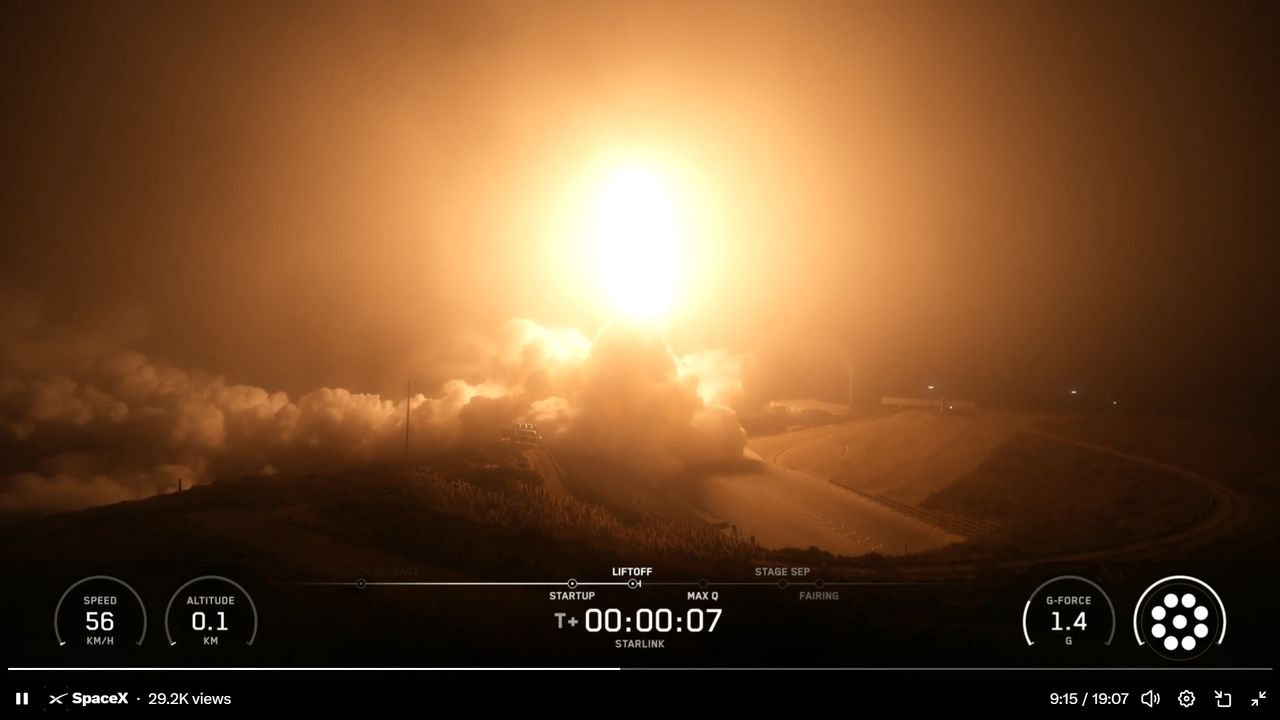
SpaceX launched another batch of its Starlink internet satellites into orbit on a predawn mission from California, continuing the company's rapid expansion of its broadband constellation. The Falcon 9 rocket lifted off from Vandenberg Space Force Base, carrying a payload of Starlink satellites destined for low Earth orbit.
The mission, designated Starlink 15-22, used a first-stage booster that had flown multiple times before. After stage separation, the booster returned to Earth and landed on a droneship stationed in the Pacific Ocean, marking another successful recovery in SpaceX's reusable rocket program. The company has made booster reuse a cornerstone of its operations, aiming to reduce the cost of space access and increase launch cadence.
This launch is part of SpaceX's ongoing effort to build out the Starlink constellation, which now numbers thousands of operational satellites. The network is designed to provide high-speed internet access to underserved and remote areas around the globe, as well as to maritime, aviation, and government customers. With each mission, SpaceX adds more capacity and coverage to the system, which has already drawn both commercial subscribers and regulatory scrutiny.
The predawn timing of the launch was chosen to optimize orbital insertion and to avoid weather constraints. SpaceX typically launches Starlink missions on a frequent schedule, sometimes multiple times per week, as it works toward its goal of global connectivity. The company has received approval from the Federal Communications Commission to deploy tens of thousands of satellites in the coming years, though it has faced pushback from astronomers concerned about light pollution and from competitors arguing about market dominance.
Starlink has become a significant revenue stream for SpaceX, helping to fund its ambitious projects, including the Starship spacecraft and the Artemis lunar lander program. The service has been particularly valuable in disaster response and in providing connectivity to areas with limited infrastructure. In recent years, Starlink has also been used by military forces in conflict zones, highlighting its strategic importance.
The successful launch and booster recovery underscore SpaceX's operational maturity and its ability to maintain a high launch tempo. The company has now launched hundreds of Starlink satellites this year alone, and the constellation continues to grow. As the network expands, SpaceX is also working on next-generation satellites that will offer direct-to-cellphone connectivity, potentially broadening its user base even further.
This mission adds to the growing body of evidence that reusable rockets are viable for routine spaceflight, a shift that has transformed the launch industry. Other companies and space agencies are now following suit, developing their own reusable systems to compete in the new space economy. For now, SpaceX remains the dominant player, with a launch manifest that shows no signs of slowing down.
121