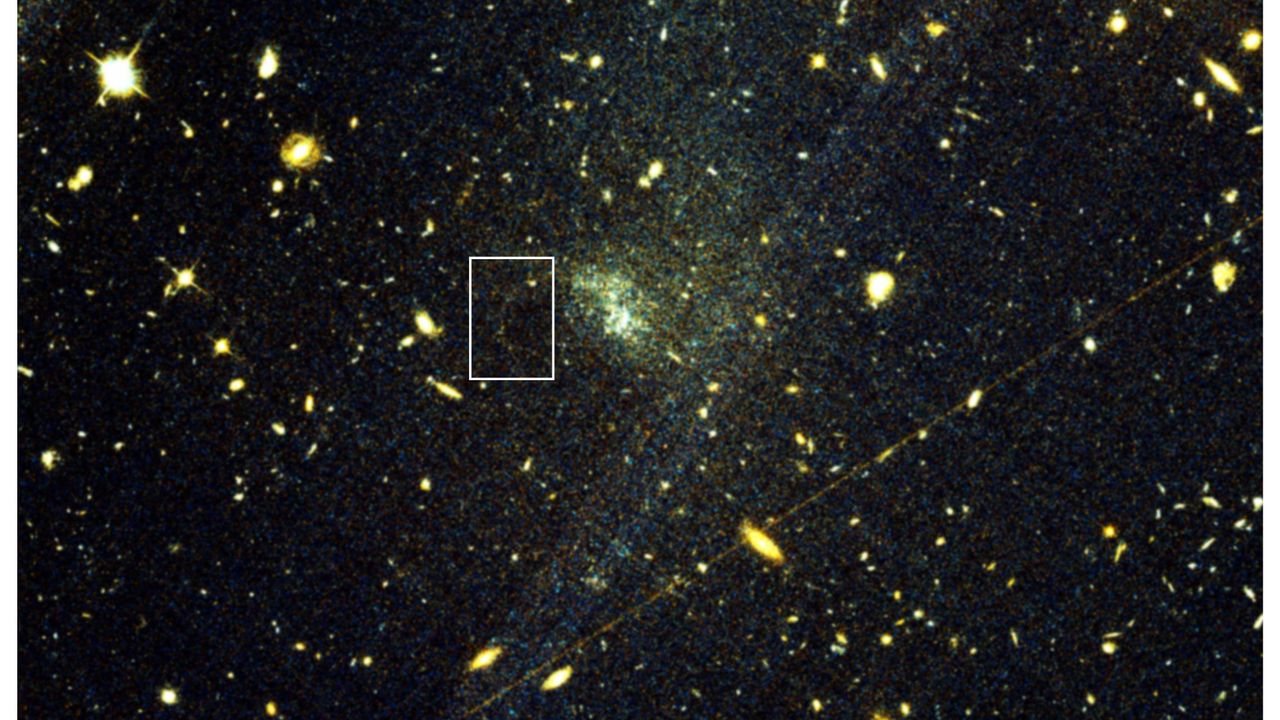
Astronomers have discovered a faint stream of stars in a distant galaxy, marking the first time such a structure has been observed outside the Milky Way and opening a new avenue for measuring dark matter in other galactic systems. The stellar stream, a trail of stars pulled from a globular cluster by gravitational forces, was found in the ultra-diffuse galaxy UGC 9050-Dw1, located about 115 million light-years from Earth.
The discovery began with a chance look at archival images from the Hubble Space Telescope. David Hendel, an astronomer, noticed a subtle arc against the darkness of the galaxy while examining portraits of UGC 9050-Dw1. The arc resembled the shape of a stellar stream, a structure well known in our own galaxy but never before seen in another. A detailed analysis confirmed the structure, and by studying the orbits of the stars within the stream, the research team was able to estimate the galaxy's dark matter content.
The findings, published in Nature on August 12, were led by astronomers Julie Kiel Holm and Sarah Pearson of the University of Copenhagen and the Technical University of Denmark. The team generated thousands of simulations to reproduce the stellar stream, and the model that best matched the observations allowed them to estimate the total mass of the galaxy and its distribution. Because the visible matter, such as stars, accounts for only a fraction of that mass, the remainder must be dark matter, the invisible substance that makes up about 85 percent of all matter in the universe.
«The stars of a stellar stream all follow nearly the same orbit, and this orbit is shaped by the gravity of the galaxy,» said Tjitske Starkenburg, a coauthor of the study. Stars stripped from a globular cluster do not scatter onto chaotic trajectories but instead settle onto similar orbits that retain a memory of the gravitational forces that shaped them. «By modeling the gravity, we can estimate the total mass of the galaxy,» Starkenburg explained. «We already know approximately how much of this mass comes from visible matter, like stars, so the rest must be dark matter.»
Previous estimates of dark matter in UGC 9050-Dw1 had been made using other methods, and the new result is fully consistent with those earlier measurements. Like other ultra-diffuse galaxies, UGC 9050-Dw1 appears to be rich in dark matter. «Our results are consistent with previous studies and with what they have shown about dark matter in this ultra-diffuse galaxy,» said Kiel Holm. «We are measuring this component in a completely new way for this type of galaxy, demonstrating that this method works even beyond our galaxy.»
The discovery opens the possibility of revealing dark matter's secrets in other galaxies where such streams have been too faint to detect. The light radiating from these structures is extremely weak, imperceptible to many sophisticated telescopes, which is why they have remained hidden until now. The successful application of this method beyond the Milky Way provides astronomers with a new tool for probing the dark matter content of galaxies throughout the universe.
138