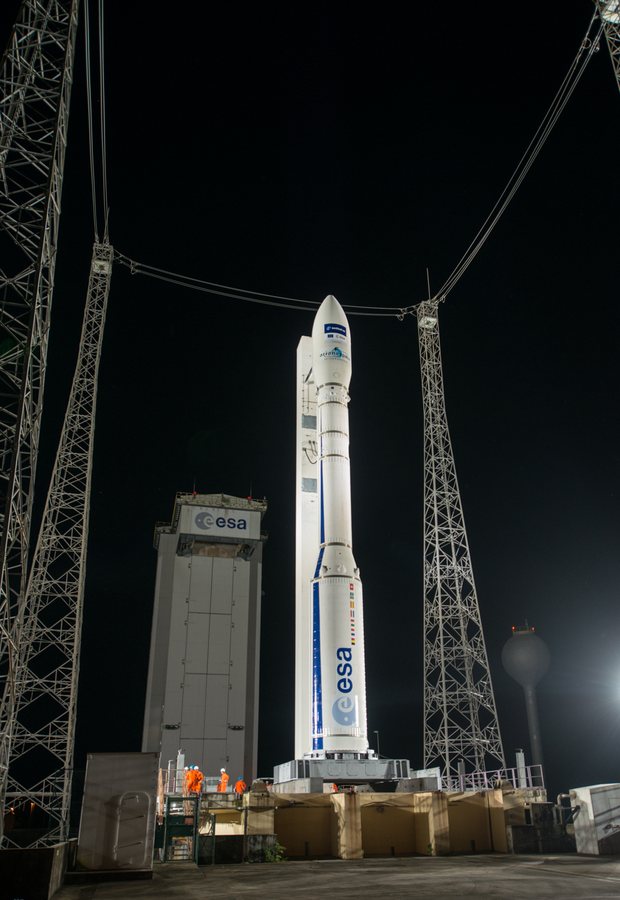
Avio S.p.A. is preparing to launch the European Space Agency's Sentinel-3C and FLEX spacecraft on a single Vega C rocket from the ELV launch pad at Kourou, French Guiana. The VV30 mission is scheduled for 01:21 UTC on Tuesday, Sept. 15, with an instantaneous launch window. The rocket will follow a northerly trajectory to place its payloads into a sun-synchronous orbit inclined 98.6 degrees to the Equator at an altitude of about 810 kilometers.
That orbit will allow both satellites to observe the entire surface of the Earth and to pass over any given location at the same local time each day, a key requirement for consistent environmental monitoring. The mission is expected to last 116 minutes from liftoff to final payload separation. Sentinel-3C will separate at T+1:00:49, shortly after the second ignition of the AVUM+ fourth stage at T+55:28. FLEX will separate at T+1:56:03, followed by a fifth and final burn to dispose of the stage and reduce the space debris hazard.
The 1,143-kilogram Sentinel-3C satellite is the centerpiece of the mission and one of four Sentinel-3 family Earth observation satellites developed under ESA's Copernicus Programme. The first two, Sentinel-3A and 3B, launched from Plesetsk Cosmodrome in Russia in 2016 and 2018 aboard Rockot launch vehicles. Sentinel-3C and the future Sentinel-3D will extend the original mission as the older satellites age out, carrying the program's data record into the 2030s.
Sentinel-3C carries a suite of instruments designed to observe the planet with complementary tools. A sea and land surface temperature radiometer can measure global sea temperatures to within 0.3 degrees Celsius, operating in the visible, near-infrared, and short-wave infrared portions of the electromagnetic spectrum. An ocean and land color instrument uses five cameras to provide a wide field of view and is a medium-resolution imaging spectrometer capable of measuring in 21 bands from 400 to 1020 nanometers.
A synthetic aperture radar altimeter measures the topography of ice and water bodies, including sea ice, ice sheets, rivers, and lakes, with a 300-meter resolution and a total range error of up to three centimeters. The radar operates in the C and Ku bands and uses a microwave radiometer for atmospheric correction, along with Doppler orbitography and radio positioning integrated with a satellite receiver for orbital positioning. The satellite also carries a microwave radiometer to measure water vapor, thermal radiation emitted by the Earth, and cloud water content, as well as a laser retroreflector and a global navigation satellite system receiver.
The 397-kilogram FLEX satellite, also built by Thales Alenia Space, carries the Floris fluorescence imaging spectrometer. This instrument will measure vegetation fluorescence on a global scale. When plants convert sunlight and carbon dioxide into oxygen, their photosynthetic activity is invisible to the naked eye but detectable by Floris. Scientists will use FLEX measurements to assess plant stress and health and to determine how photosynthesis affects Earth's carbon and water cycles.
Sentinel-3C arrived at the launch site in July 2026 along with FLEX. Together, the two missions will add to Europe's existing portfolio of Earth science missions. The flight is only the second for the Vega C program since Avio took full responsibility for Vega launch services from Arianespace, and it is the second Vega C launch of 2026 after the SMILE mission on May 18. The VV30 mission will be followed by the IRIDE Mission 2, Space Belt, and IRIDE Mission 1 flights, also currently scheduled for 2026.
The Vega C program has a mixed record. The Pleiades Neo 5 and 6 mission failed on Dec. 21, 2022. The last five Vega C missions, including the Sentinel-1C satellite, all succeeded, giving the rocket a record of seven successes in eight attempts to date.