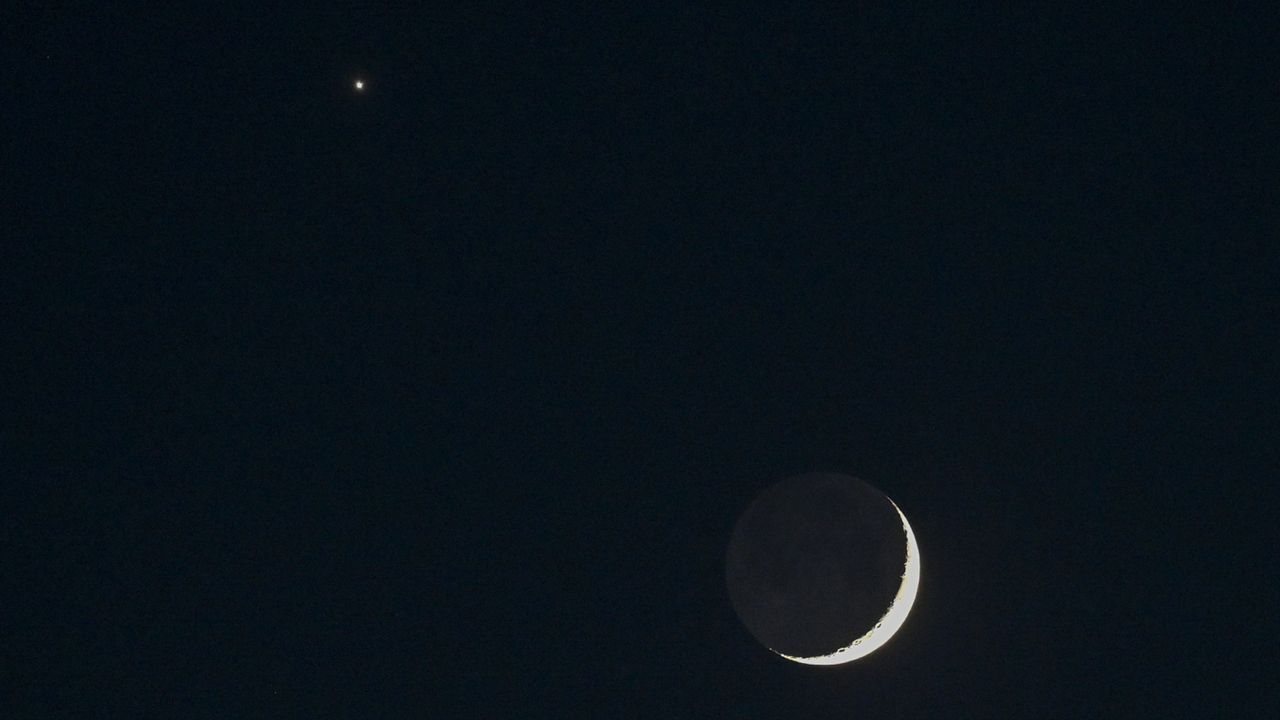
Venus will appear beside a thin crescent moon in the western sky shortly after sunset tonight, offering one of the most accessible celestial pairings of the year for observers across the United States. The two brightest objects in the night sky after the sun will sit close together in the fading twilight, visible to the naked eye without any special equipment.
The crescent moon will be a slim sliver of light, illuminated only along its lower edge as it approaches the new moon phase. Venus, meanwhile, will shine as a brilliant white point of light nearby, far outshining any star in that part of the sky. The pair will be positioned low on the western horizon, meaning the window for viewing will be relatively brief after the sun goes down.
For the best view, astronomers recommend finding a location with an unobstructed view of the western horizon, away from tall buildings, trees, or hills that could block the low-hanging objects. The pairing will become visible as the sky darkens, roughly 30 to 45 minutes after sunset, and will gradually sink toward the horizon as the evening progresses. Binoculars can enhance the view, but they are not necessary to enjoy the spectacle.
Venus is currently in its evening apparition, appearing in the western sky after sunset. The planet orbits closer to the sun than Earth, which is why it is never seen far from the sun in our sky. Depending on its position in its orbit, Venus can appear as either a morning star or an evening star, and it is currently playing the role of the evening star.
The crescent moon, meanwhile, is in its waxing phase, growing slightly larger each night until it reaches first quarter and then full moon. Tonight's pairing is a coincidental alignment from Earth's perspective, as the moon and Venus are actually separated by tens of millions of miles in space. The moon is roughly 240,000 miles from Earth, while Venus is currently about 100 million miles away.
Such conjunctions between the moon and bright planets are common but not always this striking. Venus is the third-brightest object in the sky after the sun and moon, so its proximity to the crescent moon creates a particularly eye-catching scene. The pairing will be visible from most locations across the United States, weather permitting, though clouds or haze could obscure the view in some regions.
Skywatchers who miss tonight's event will have other opportunities in the coming weeks. The moon will continue its monthly cycle, and Venus will remain in the evening sky for several more months before gradually sinking toward the sun and eventually transitioning to the morning sky. Other planets, including Jupiter and Saturn, are also visible at various times, though not necessarily in the same part of the sky tonight.
For those hoping to capture the moment, a camera with a telephoto lens or even a smartphone can record the pairing, though a tripod will help steady the shot in low light. The contrast between the bright crescent and the pinpoint of Venus can be challenging to photograph, but the scene is primarily one to enjoy with the unaided eye.
No special equipment or expertise is required to observe the conjunction. Simply step outside after sunset, face west, and look for the thin crescent moon. Venus will be the bright point of light nearby, unmistakable against the twilight glow. As the sky grows darker, more stars will emerge, but Venus will remain one of the most prominent objects until it sets.
The event is part of the regular rhythm of the solar system, as the moon and planets trace their orbits and occasionally appear to line up from our vantage point on Earth. Such moments offer a reminder of the dynamic nature of the night sky and a chance for casual observers to connect with the broader cosmos.