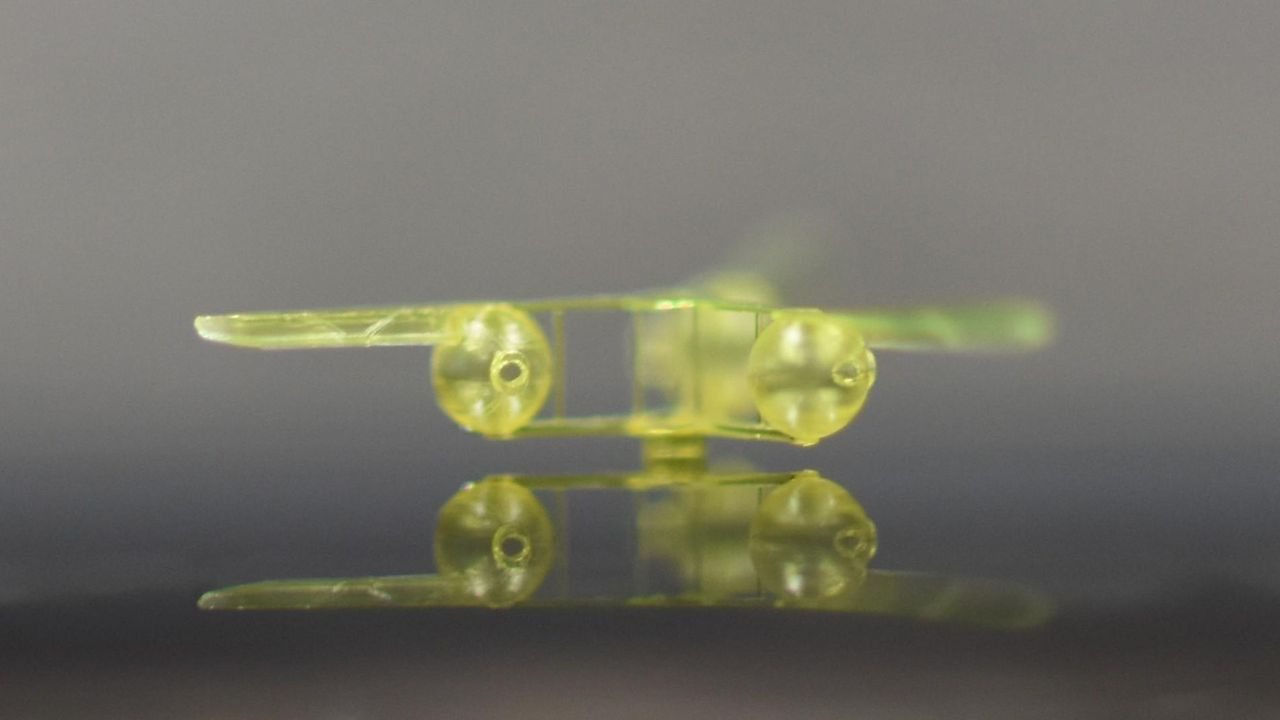
Researchers have created tiny robots, smaller than a penny, that can fly without any motors or moving parts, relying instead on the power of sound waves to levitate and propel themselves through the air. The development, detailed in a new study, marks a significant step in microrobotics and could open the door to applications ranging from targeted drug delivery to environmental monitoring in spaces too small for conventional machines.
The robots, which measure just a few millimeters across, are designed to harness acoustic fields. By manipulating the frequency and intensity of sound waves, the scientists were able to lift the devices off the ground and control their movement in midair. The approach eliminates the need for the miniature engines, gears, and propellers that typically complicate the construction of robots at this scale, offering a simpler and more robust design.
Sound waves exert a physical force on objects in their path, a principle that has been explored for contactless manipulation in laboratories. The new work applies this concept to free-flying robots, demonstrating that acoustic pressure alone can provide both the lift and the thrust needed for controlled flight. The team behind the project says the robots can hover, change direction, and even perform simple maneuvers, all without a single mechanical component onboard.
The absence of motors is a key advantage. Conventional micro-robots often struggle with power supply and the wear and tear of moving parts, which limits their lifespan and reliability. The sound-powered design sidesteps these issues entirely, as the robots are essentially passive structures that respond to external acoustic energy. This could make them cheaper to produce and more durable in demanding environments.
While the current prototypes are experimental, the potential uses are broad. In medicine, such robots could one day navigate through the body to deliver drugs to specific tissues or assist in minimally invasive procedures. In industry, they could be used to inspect confined spaces, such as pipelines or machinery, where larger devices cannot reach. The ability to control them wirelessly through sound also means they could operate in areas where radio signals are ineffective.
The research builds on a growing body of work in acoustic levitation, which has previously been used to float liquids and small objects in laboratory settings. The new study extends this concept by demonstrating sustained, controllable flight of a free-moving robot. The scientists note that further refinement is needed to improve maneuverability and to develop ways to power the robots over longer distances, but the principle has been proven.
The work highlights how fundamental physics can translate into practical engineering breakthroughs. By moving away from traditional mechanical designs, the researchers have shown that sound waves, a ubiquitous and safe form of energy, can serve as a viable power source for the next generation of miniature machines. As the technology matures, these tiny flyers could become a common tool in both scientific research and real-world applications.
185