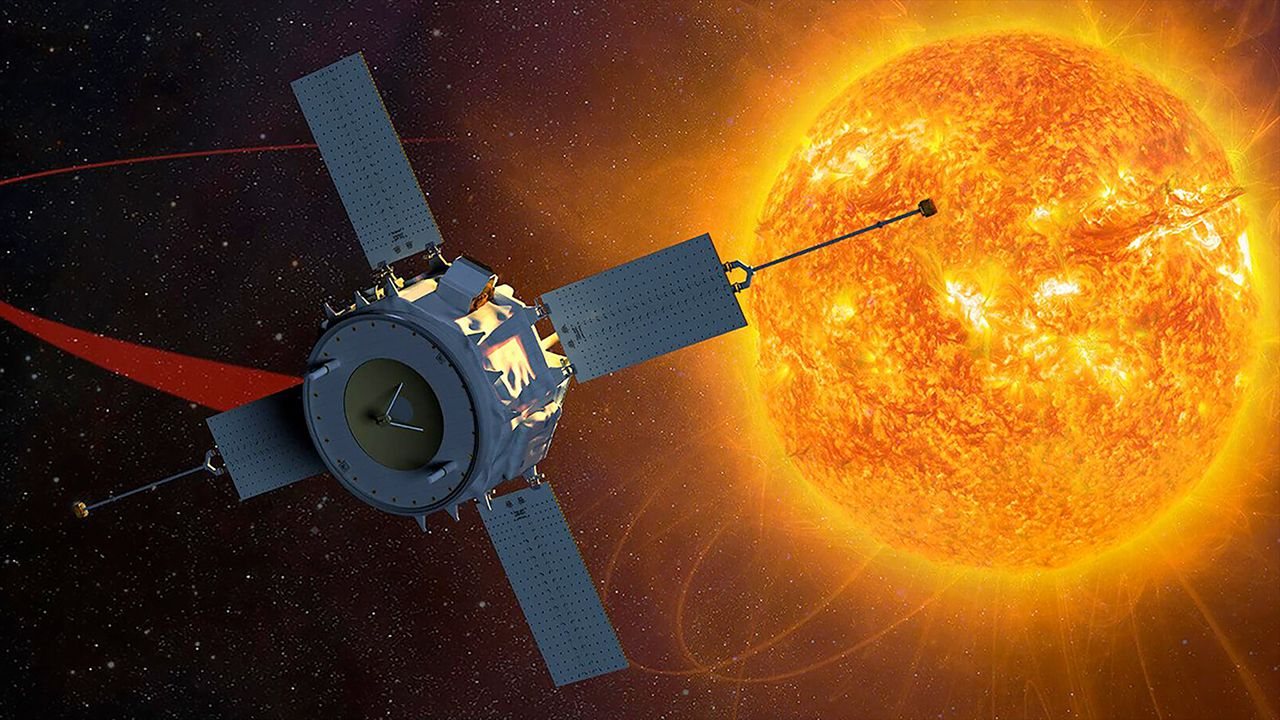
Twenty-eight years ago, NASA launched the Advanced Composition Explorer (ACE), a spacecraft designed to monitor the solar wind and cosmic particles, providing critical data for understanding space weather and its effects on Earth. The mission, which lifted off on Aug. 25, 1997, has since become a cornerstone of solar and heliospheric research, operating far beyond its original design lifetime.
ACE orbits the Sun-Earth L1 Lagrange point, a gravitationally stable position about 1.5 million kilometers from Earth, where it continuously samples the solar wind, interplanetary particles, and cosmic rays. Its instruments measure the composition of these particles, helping scientists study the Sun’s activity, the formation of the solar wind, and the acceleration of energetic particles. The data are also used for real-time space weather alerts, protecting satellites, astronauts, and power grids from solar storms.
The mission was developed by NASA’s Goddard Space Flight Center and the California Institute of Technology, with contributions from multiple research institutions. ACE carries nine instruments, including spectrometers and particle detectors, which have provided a continuous record of solar and cosmic particle behavior for nearly three decades. This long-term dataset has been invaluable for studying the 11-year solar cycle and the heliosphere’s structure.
Beyond its scientific contributions, ACE has become a key asset for space weather forecasting. The National Oceanic and Atmospheric Administration (NOAA) uses ACE data to issue alerts about geomagnetic storms and solar energetic particle events, which can disrupt communications, navigation systems, and electrical infrastructure. The spacecraft’s longevity has exceeded all expectations, with its fuel supply and instrumentation still functioning well into the 2020s.
The launch of ACE was part of a broader era of solar exploration, following missions like the Solar and Heliospheric Observatory (SOHO) and preceding the Parker Solar Probe, which later provided even closer observations of the Sun. ACE’s position at L1 allows it to serve as an early warning system, detecting solar disturbances before they reach Earth, a role that remains crucial as society becomes more reliant on technology vulnerable to space weather.
Researchers continue to use ACE data to study fundamental questions about the Sun, the solar wind, and cosmic rays. The mission has also contributed to understanding the heliosphere’s interaction with interstellar space, as it has detected particles from beyond our solar system. As ACE continues to operate, it stands as a testament to the value of long-duration space missions in advancing scientific knowledge and protecting modern infrastructure.
147