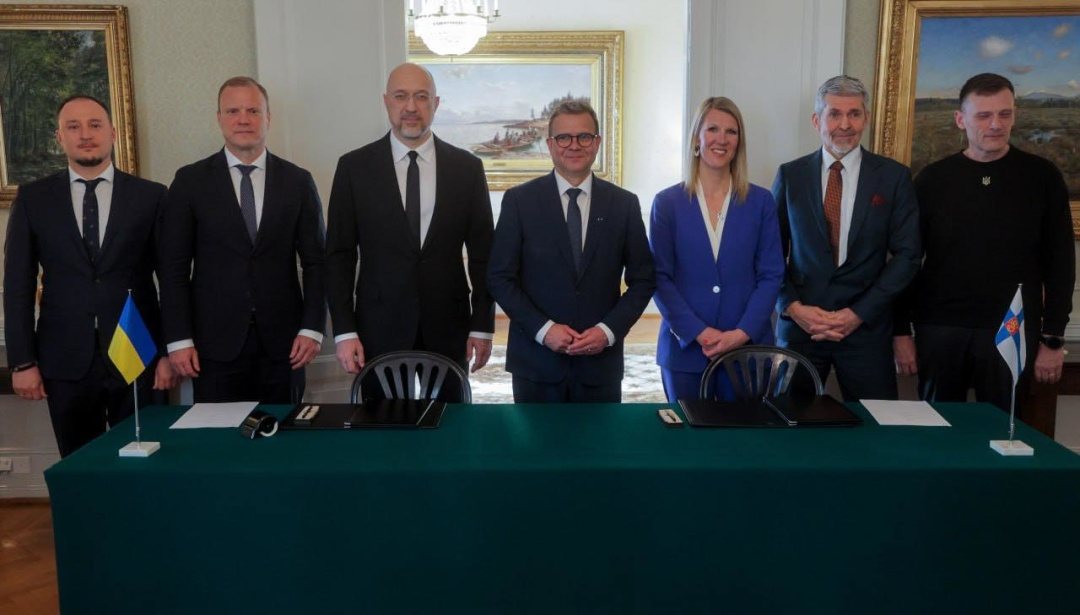
Finland is allocating about €28.5 million in development-cooperation funding for power-plant technology in Ukraine, while Ukraine finances the remaining portion of a €46.5 million technology package. Beyond the financing, the project belongs to a broader technical effort to expand distributed generation—smaller, flexible power units deployed across multiple regions rather than concentrated in a few large plants.
The financing split leaves roughly €18 million to Ukraine. That matters because distributed energy systems require more than the generating equipment itself. Sites need electrical connections, fuel supply, controls, protection systems, maintenance and operators. Co-financing gives Ukraine a direct stake in integrating the technology rather than treating it as a standalone donated asset.
The technical context became clearer in May, when Ukrnafta and Finnish technology company Wärtsilä signed a framework agreement for equipment to build distributed-generation facilities. Ukrainian officials described the programme as a staged rollout of gas-engine generation implemented with the Finland–Ukraine Investment Facility. The first phase had already attracted an €80 million loan from the European Bank for Reconstruction and Development.
Gas-engine plants are relevant to a grid under attack because they can provide dispatchable generation. Unlike weather-dependent solar or wind, an engine-based unit can be called on when power is needed, subject to fuel availability and operating constraints. That makes such plants useful for balancing supply and demand and for supporting local systems after larger assets are damaged.
In June, Ukraine’s government said nearly 939 million hryvnias would be directed through Finnish-Ukrainian cooperation to Ukrnafta projects in the Ivano-Frankivsk and Lviv regions. The stated combined capacity was up to 60 megawatts. Those projects illustrate the geographic logic of distributed generation: capacity is placed at separate sites so that a single strike or grid failure has a smaller system-wide effect.
Finland’s development programme for Ukraine treats energy security and climate resilience as linked priorities. Its bilateral cooperation budget for 2024–2028 is at least €320 million. The programme calls for modern energy solutions while acknowledging that Russia’s attacks have caused large-scale destruction of generating plants and the power grid.
The Finland–Ukraine Investment Facility adds an industrial mechanism to that policy. It was designed to finance up to €50 million of public-sector projects in 2025–2026, connecting Ukrainian needs with Finnish technology, products and expertise. In engineering terms, this matters because long-term performance depends not just on purchasing hardware but on obtaining reliable systems, service and technical support.
Distributed generation is not a complete solution to Ukraine’s energy vulnerability. Fuel infrastructure can also be attacked, smaller plants still need grid connections, and many units require physical protection. Large thermal, nuclear, hydro and renewable resources remain essential. The advantage is redundancy: more independent sources give operators more options when parts of the network fail.
The next meaningful data point will be commissioning. Once equipment is installed, analysts can assess actual capacity, efficiency, availability and operating role. Until then, the €28.5 million allocation is a financing milestone. Its scientific and engineering significance will emerge only when the machines begin supplying power under real wartime grid conditions.
99