Virtual reality has been “almost here” for longer than the personal computer has been ordinary.
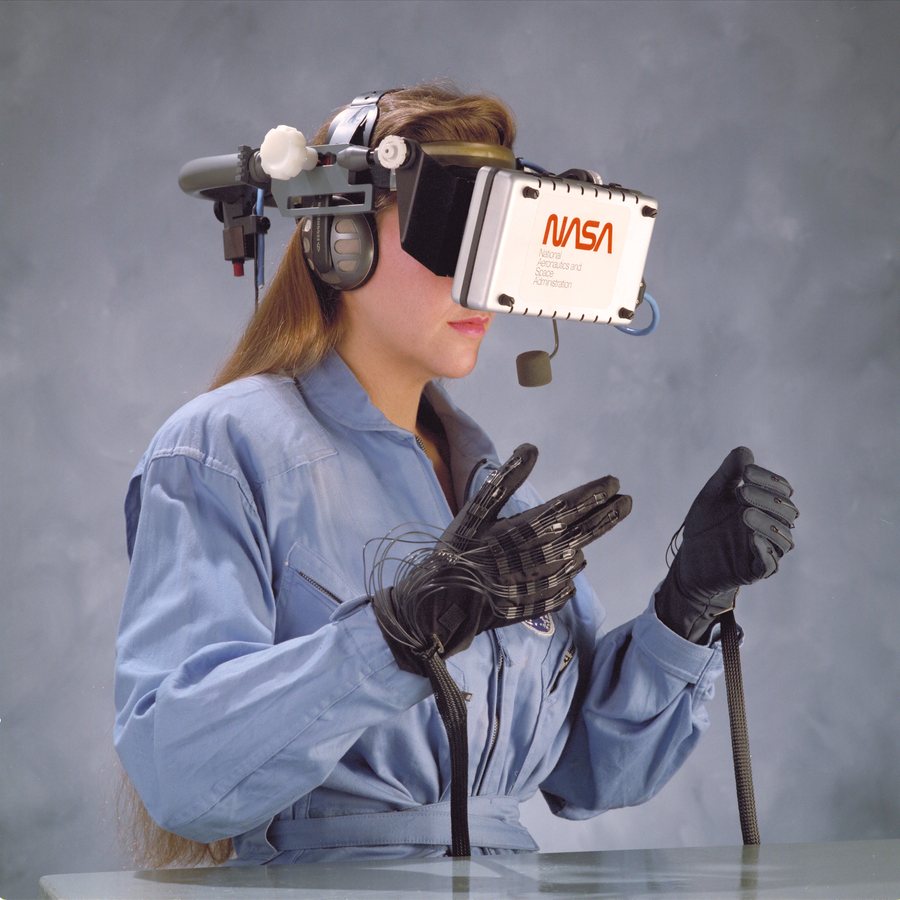
In 1968, computer scientist Ivan Sutherland described a head-mounted three-dimensional display built around an idea that still defines modern VR: the image should change as the user moves their head, creating the visual logic of a three-dimensional world. By the late 1980s, NASA Ames was operating a wide-angle stereoscopic system called VIEW, controlled through head position, voice and gesture. The hardware looked primitive by today’s standards, but the ambition was already familiar — let a person enter a computer-generated space rather than merely look at one.
Nearly six decades later, the central promise is still compelling. Modern headsets can track hands and eyes, map rooms, render detailed worlds and place giant virtual screens in small apartments. Yet the headset itself has still not become an everyday computer for most people.
That is the recurring story of VR: breakthrough, excitement, investment, disappointment, retreat — and then another breakthrough.
The 1990s delivered one of the first consumer warnings. Nintendo’s Virtual Boy arrived in 1995 with stereoscopic imagery and futuristic branding, but sold only about 770,000 units worldwide before disappearing. Its red display, awkward tabletop posture and thin software library made the gap between the idea of immersion and the reality of using the machine impossible to ignore.
The next mass experiment came from a device that was almost comically simple. Google Cardboard turned a smartphone into a basic VR viewer and had reached five million users by early 2016. Google then tried to turn that curiosity into a higher-quality mobile platform with Daydream. Daydream promised accessible VR built around compatible phones, a soft headset and a controller. The software is now unsupported and the headset is no longer sold.
The cycle did not end. It became much more expensive.
Oculus revived belief that VR could finally escape the laboratory and arcade. Facebook agreed to buy Oculus in 2014 for about $2 billion, saying at the time that virtual reality could become the next social and communications platform. The consumer Oculus Rift followed in 2016 at $599. Tracking improved, latency fell, displays became sharper and a modern VR software ecosystem began to form.
Then Mark Zuckerberg made the largest bet in the history of the category.
In October 2021, Facebook renamed itself Meta and said its focus would be bringing the metaverse to life. The language was bigger than gaming. The metaverse was presented as a successor to today’s online social experience — a place for work, connection, commerce and shared presence.
Measured against that ambition, the consumer metaverse has so far fallen dramatically short.
Meta’s own financial statements show the scale. Reality Labs recorded operating losses of $6.6 billion in 2020, $10.2 billion in 2021, $13.7 billion in 2022, $16.1 billion in 2023, $17.7 billion in 2024 and $19.2 billion in 2025. In the first six months of 2026 it lost another $8.6 billion. Added together, that is roughly $92.2 billion in operating losses since 2020.
That number needs an important qualification. Reality Labs is not a pure “metaverse spending” account. Meta uses the segment for virtual- and augmented-reality hardware, software and content, and its longer-term work also includes wearables and foundational technologies. Some of those projects may eventually produce products very different from a VR headset.
But the financial mismatch is still extraordinary. Reality Labs generated $2.2 billion of revenue in 2025 while posting a $19.2 billion operating loss. In the first half of 2026, it produced $833 million of revenue against an $8.6 billion operating loss. Meta can sustain that because its advertising businesses remain enormously profitable. The headset business itself has not validated the scale of the original platform bet.
The market data tells a similar story. Counterpoint Research said global VR-headset shipments fell 12 percent in 2024, the third consecutive annual decline. In 2025, IDC found that the broader XR market rebounded sharply — but the growth came primarily from smart glasses, while traditional VR and mixed-reality headsets continued to decline. Meta remained the dominant XR vendor, yet IDC said Quest headset shipments fell 42.3 percent year over year.
That distinction matters. Consumers are not rejecting every computer that can be worn on the face. They appear more receptive when the device behaves more like ordinary eyewear and asks less of them.
IDC’s 2026 outlook illustrates the shift. It expects around 13.6 million display-less smart glasses to ship this year, compared with roughly 3.2 million mixed-reality devices. The fastest-moving part of extended reality is becoming less immersive, not more.
Apple supplied perhaps the clearest test of whether superior engineering could break the pattern.
Vision Pro launched in the United States in February 2024 at $3,499. Apple avoided the language of the metaverse and called the device a “spatial computer.” Its eye-and-hand interface solved many of the clumsy controller problems associated with earlier headsets, its displays made text and video unusually convincing, and passthrough video kept the physical room visible.
But Apple did not repeal the physics of wearing a computer on the head. The current M5 model still starts at $3,499. Apple lists the headset itself at 750 to 800 grams, depending on configuration, while its separate battery weighs another 353 grams. The battery is rated for up to two and a half hours of general use.
Apple’s 2025 revision is revealing in another way: it introduced a new Dual Knit Band with a counterweight specifically to improve comfort and balance. That is a sophisticated response to a very old problem.
Laboratory evidence explains why these problems are not cosmetic. A 2020 systematic review and meta-analysis covering 55 VR studies and 3,016 participants found that sickness symptoms varied with content, visual stimulation, locomotion and exposure time. Later research continues to treat cybersickness, visual fatigue, usability and physical ergonomics as meaningful constraints. A 2025 ergonomics study involving 88 participants found that both headset weight and center of mass affect comfort during prolonged wear.
The deeper obstacle, however, is not nausea alone.
A technology can be imperfect and still become universal if it gives people enough value. Smartphones had short battery life, small screens and fragile glass, but they combined communication, maps, cameras, payments and the internet in a device people already carried. The cost of using one was usually a glance downward.
A headset asks for more. The user must put something on the face, adjust it, tolerate its weight, remain aware of a battery, accept some separation from the people in the room and enter a software environment that may not contain the apps or social activity they use most. Even when the virtual image is excellent, the ritual of getting there can be worse than opening a laptop or picking up a phone.
Research on VR adoption supports that broader explanation. A 2024 systematic review of 158 studies identified perceived enjoyment, ease of use, social influence, previous experience and consumer attitudes among the recurring drivers of adoption. Other work links continued use to perceived usefulness and ease of use. Presence is valuable, but presence by itself is not a mass-market use case.
This is why the history of VR should not be reduced to a sequence of bad products. The hardware has improved enormously. Modern headsets can do things Sutherland’s 1968 system could only suggest. In some settings — simulation, training, medicine, design and games — immersion can justify the friction because the task itself benefits from spatial presence.
The mass-market question is different. It asks whether millions of people want to wear a headset for ordinary computing when a phone, television or laptop already completes the job with less effort.
So far, the answer has repeatedly been no.
That does not make Meta’s entire Reality Labs effort worthless, nor does it prove that Apple Vision Pro will never lead to a larger platform. It means the original promise has moved. The most commercially promising branch of XR in 2026 is increasingly the one that looks least like the sealed virtual worlds imagined in earlier hype cycles: lighter glasses, ambient AI, cameras, audio and selective digital information layered onto ordinary life.
The next breakthrough may therefore come not when virtual reality finally becomes realistic enough to replace reality, but when the technology stops demanding that people leave reality in order to use it.
73